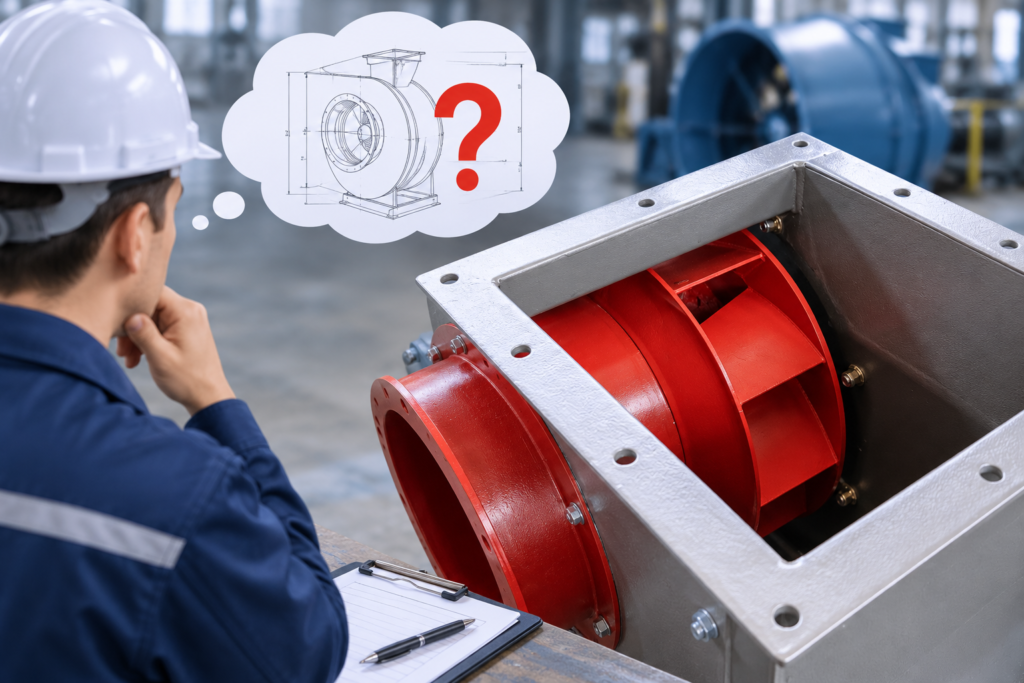

Choosing between an axial fan and a centrifugal fan is not simply a matter of comparing airflow or motor power. The correct choice depends on the required operating point, system resistance, installation layout, air properties, and operating conditions.
Both fan types are widely used in industrial ventilation, mining, manufacturing, and process systems. However, their aerodynamic designs make them suitable for different duties. Understanding these differences helps engineers specify the right equipment and avoid problems such as insufficient airflow, excessive noise, unstable operation, and unnecessary energy consumption.
Quick Takeaways
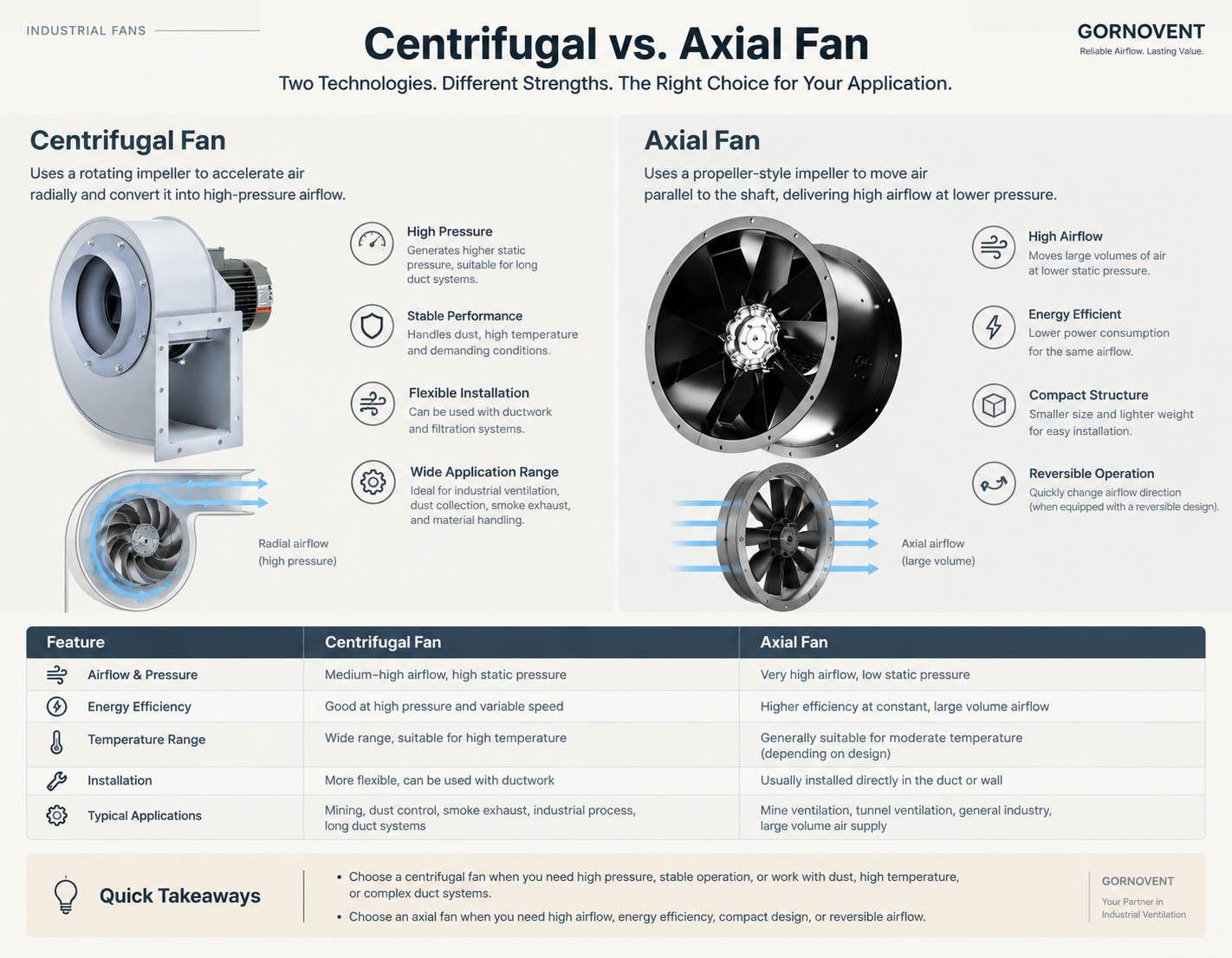
- Axial fans move air approximately parallel to the impeller shaft. They are commonly used for large airflow volumes where the system resistance is compatible with the fan’s pressure capability.
- Centrifugal fans discharge air approximately perpendicular to the impeller shaft after accelerating it radially. They are often selected for systems with higher pressure requirements or complex ductwork.
- Neither type is automatically more efficient. Efficiency depends on the selected fan, operating point, impeller design, motor, and system configuration.
- The fan must be selected against the required airflow and pressure at the same operating condition, not by comparing maximum airflow or motor power alone.
- Air temperature, density, dust loading, corrosive components, installation space, noise limits, and motor requirements can affect the final selection.
1. What Is the Difference Between an Axial Fan and a Centrifugal Fan?
The main difference is the direction in which air passes through the impeller and leaves the fan. This affects the fan’s pressure-flow characteristics, casing design, installation arrangement, and suitability for different systems.
Axial fans
An axial fan moves air mainly along the axis of rotation. Air enters the impeller and continues in approximately the same direction as it passes through the fan.
Axial fans are commonly used in ventilation duties requiring substantial airflow through a relatively direct air path. Depending on their design, they may use fixed-pitch or adjustable-pitch blades, guide vanes, or multiple impeller stages.
Typical applications include:
- General industrial ventilation and air circulation.
- Mine and tunnel ventilation.
- Equipment cooling and heat removal.
- Ventilation through ducts where the selected fan can overcome the system resistance.
- Applications requiring reversible airflow, when the fan is specifically designed and rated for that duty.
Centrifugal fans
A centrifugal fan draws air into the impeller, usually near its center, and accelerates it radially outward. The casing collects the air and directs it toward the outlet.
This configuration is widely used in systems where pressure generation, discharge arrangement, or the handling of particular air streams is important. The achievable pressure and efficiency depend on the impeller geometry, blade arrangement, rotational speed, and operating point.
Typical applications include:
- Industrial process ventilation and forced-draft air supply.
- Dust collection and filtration systems, where the fan is suitable for the conveyed particles and system conditions.
- Combustion-air supply and other process-air duties.
- Ventilation systems with significant duct, filter, or equipment resistance.
- Applications requiring corrosion-resistant construction or specialized impeller materials.
These are general application patterns, not absolute rules. Some axial fans are designed for relatively high pressures, while some centrifugal fans are designed primarily for high-volume, low-pressure duties. Selection must be based on the actual fan performance data.
2. Axial vs. Centrifugal Fans: Key Differences
| Selection factor | Axial fan | Centrifugal fan |
|---|---|---|
| Airflow direction | Approximately parallel to the shaft | Enters near the impeller center and moves radially outward before discharge |
| Common design objective | High airflow through a relatively direct path | Air delivery matched to pressure, discharge, and process requirements |
| Pressure capability | Varies widely by design, stage count, and speed | Varies widely by impeller type, geometry, and speed |
| Installation | Often suitable for inline or straight-through arrangements | Often requires space for the casing and outlet arrangement |
| Duct and system resistance | Must be checked against the fan curve and system curve | Must be checked against the fan curve and system curve |
| Dust or particle handling | Depends on blade design, clearances, and particle characteristics | Depends on impeller design, material, wear allowance, and particle characteristics |
| Noise and vibration | Depend on aerodynamic design, speed, installation, and operating point | Depend on aerodynamic design, speed, installation, and operating point |
| Best selection method | Verify airflow, pressure, efficiency, and operating stability | Verify airflow, pressure, efficiency, and operating stability |
Important: This comparison describes common design tendencies. It should not be used as a substitute for a manufacturer’s performance curve and technical data.
3. Airflow and Pressure: The Most Important Selection Criteria
When selecting an industrial fan, start with the required operating point. Two key parameters define this duty: airflow and pressure.
Airflow
Airflow is the volume of air delivered per unit of time. Common units include m³/h and m³/s.
The required airflow is determined by the application. For example, a ventilation system may require a specified air exchange rate, while a process system may need a defined volume of air for cooling, combustion, conveying, or exhaust.
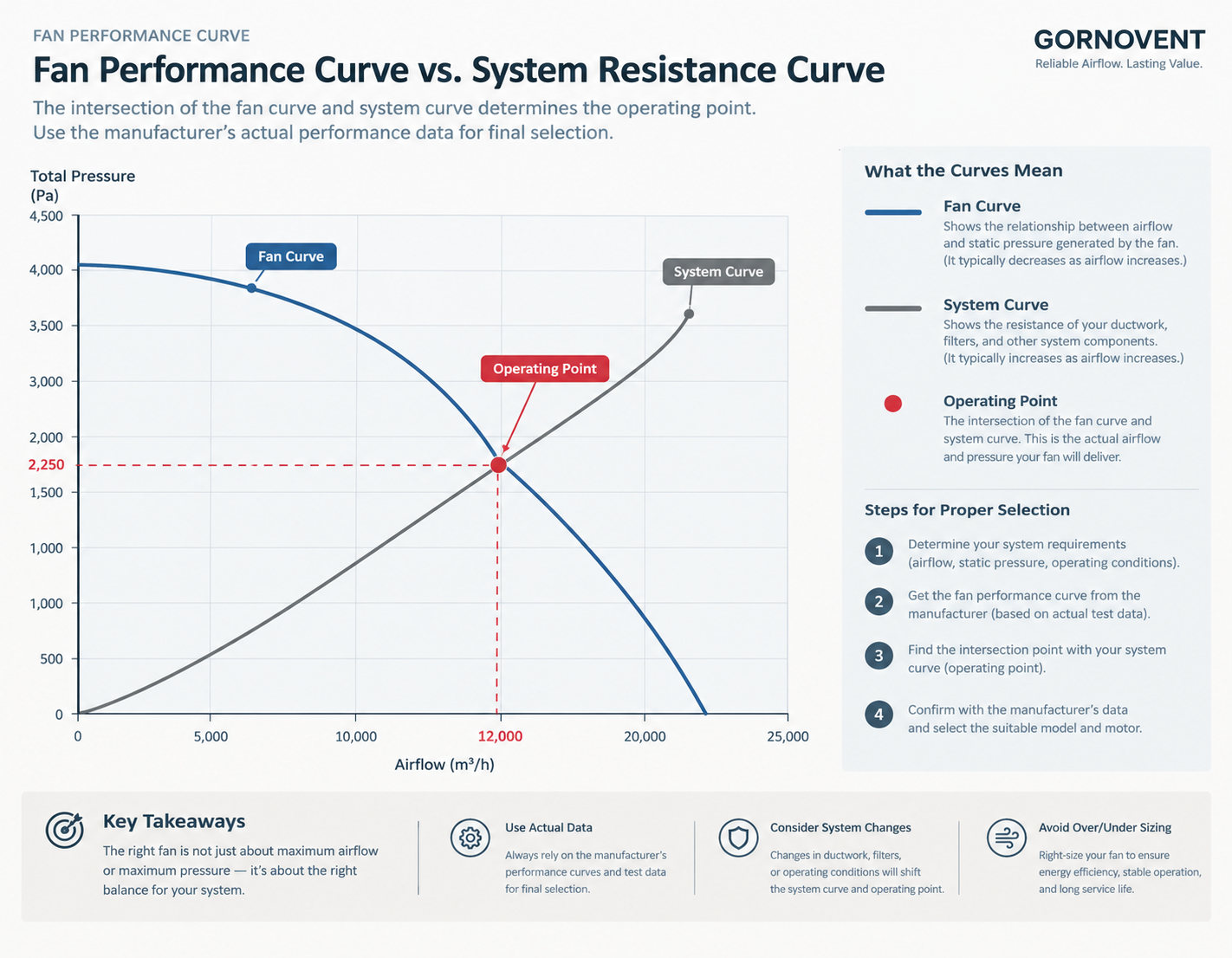
Do not assume that a fan’s published maximum airflow is the airflow it will deliver after installation. The actual operating airflow depends on the resistance of the connected system.
Pressure
The fan must generate enough pressure to overcome the resistance of the system at the required airflow. Resistance may come from duct length, bends, transitions, dampers, filters, heat exchangers, grilles, and other components.
Before comparing quotations, confirm whether the required pressure is static pressure or total pressure. These values are not interchangeable. The pressure basis used in the specification must be consistent with the manufacturer’s performance data.
Why the operating point matters
A fan does not operate at its maximum airflow and maximum pressure simultaneously. Its actual operating point is determined by the intersection of the fan performance curve and the system resistance curve.
If a fan is selected only by its maximum airflow, it may not provide enough pressure once connected to the system. Conversely, choosing an unnecessarily large fan may increase capital cost, energy consumption, noise, and control complexity.
For background on selecting underground auxiliary ventilation equipment and evaluating duct resistance, see our guide to underground auxiliary ventilation fans.
4. When Should You Choose an Axial Fan?
An axial fan is worth evaluating when the application requires a large airflow volume and the installation benefits from a straight-through flow arrangement.
Typical reasons to consider an axial fan
- The main requirement is moving a substantial volume of air.
- The available installation space favors a compact, inline, or tubular arrangement.
- The required airflow and pressure fall within the available axial fan performance range.
- The application involves ventilation, cooling, or air movement through a compatible duct system.
- Reversible operation is required and the proposed model is specifically designed for the required reversal duty.
What to check before ordering
Confirm the fan’s performance at the required operating point rather than assuming that all axial fans deliver high airflow at low pressure. Check the pressure requirement, motor power, rotational speed, blade design, noise limits, and operating stability.
For underground or tunnel applications, also confirm the installation arrangement, duct connection, environmental conditions, electrical protection, and any applicable mine-specific safety requirements.
Explore our industrial axial fan range for models that may suit your application.
5. When Should You Choose a Centrifugal Fan?
A centrifugal fan is often worth evaluating when the system requires a particular pressure level, a defined discharge arrangement, or a specialized configuration for the conveyed air.
Typical reasons to consider a centrifugal fan
- The system has substantial resistance from ducts, filters, process equipment, or other components.
- The process requires a specific pressure-flow operating point.
- The outlet direction or casing arrangement is important to the installation.
- The conveyed air requires a particular impeller material, corrosion-resistant construction, or wear-resistant design.
- The application involves process ventilation, forced-draft air supply, exhaust, or compatible dust-handling duties.
What to check before ordering
Confirm the required airflow and pressure, impeller type, rotational speed, motor power, drive arrangement, casing material, and outlet orientation. For dusty or abrasive air, check the particle size, concentration, abrasiveness, and the manufacturer’s stated limits for the proposed design.
For corrosive gas streams, identify the chemical composition, concentration, temperature, and moisture content. Material compatibility must be evaluated against the actual process conditions rather than the generic label “corrosion-resistant.”
Explore our industrial centrifugal fan range for suitable configurations.
6. Energy Efficiency: Which Fan Type Is More Efficient?
There is no universal answer. Neither axial nor centrifugal fans are inherently more efficient in every application. Efficiency depends on the selected design and how closely the operating point matches its efficient operating range.
For a fair comparison, evaluate the following factors:
- Required airflow and pressure: Both must be compared at the same duty point.
- Fan efficiency: Use the manufacturer’s performance data and confirm the efficiency definition and measurement basis.
- Motor efficiency: Motor rating, efficiency class, load, and control method affect electrical consumption.
- System losses: Poor duct layout, leakage, unnecessary restrictions, and poorly selected accessories increase the required fan duty.
- Operating hours: Small differences in power consumption can become significant in continuous-duty applications.
- Control strategy: Speed control may help match output to demand when the fan, motor, drive, and process permit it.
For a first-order estimate, the electrical energy consumed over a period can be calculated as:
Energy consumption (kWh) = Electrical input power (kW) × Operating time (h)
For example, a fan drawing 15 kW of electrical input power for 4,000 operating hours would consume approximately 60,000 kWh over that period. This is an illustrative calculation, not a performance claim for any particular fan model.
When evaluating energy savings, use actual electrical input power at the required operating conditions rather than relying solely on motor nameplate power or an advertised maximum efficiency.
7. Installation, Noise, and Maintenance Considerations
Fan selection should also account for how the equipment will be installed, operated, inspected, and maintained over its service life.
Installation space and connections
Axial fans can suit straight-through installations, while centrifugal fans often need space for the casing and discharge connection. However, the actual footprint depends on the selected model, accessories, silencers, flexible connectors, supports, and access requirements.
Check the general arrangement drawing, inlet and outlet dimensions, foundation or support loads, access for maintenance, and connection details before confirming the order.
Noise and vibration
Noise and vibration are influenced by fan speed, blade design, turbulence, inlet conditions, system restrictions, installation quality, and mechanical condition. Neither fan type is automatically quieter.
Where noise limits are specified, request the relevant sound data and confirm the measurement conditions. Where vibration limits apply, agree on the applicable measurement method, measurement locations, and acceptance criteria.
Maintenance and operating conditions
Maintenance requirements depend on bearings, drive arrangements, motor configuration, impeller design, operating environment, and duty cycle. For dusty, abrasive, hot, or corrosive applications, define inspection intervals and component requirements according to the actual service conditions.
For equipment installed in hazardous areas or underground mines, verify the applicable approvals and protection requirements for the complete proposed configuration. Do not assume that a standard industrial fan is suitable for a hazardous environment without confirmation.
8. Common Fan Selection Mistakes
Mistake 1: Selecting by airflow alone
A fan may have a high published airflow but fail to meet the required pressure once connected to the system. Specify both airflow and pressure at the intended operating point.
Mistake 2: Comparing static pressure with total pressure
These are different quantities. Confirm the pressure definition in the duty specification and use the same basis when comparing technical offers.
Mistake 3: Assuming one fan type is always more efficient
Efficiency depends on the actual design and operating point. Compare manufacturer performance curves and expected electrical input power at the required duty.
Mistake 4: Ignoring the connected system
Duct dimensions, bends, filters, dampers, leakage, and other components affect system resistance. A fan should be selected for the complete installation, not as an isolated component.
Mistake 5: Overlooking air properties and materials
Temperature, density, moisture, corrosive components, and particles may affect performance, material selection, and service life. Provide these details before the fan is finalized.
Mistake 6: Treating a quotation as proof of technical suitability
A quotation should identify the proposed model, duty point, motor data, construction, and deviations from the specification. Final suitability must be checked against the technical requirements and supporting documentation.
9. Information Needed for a Fan Selection or Quotation
To evaluate an axial or centrifugal fan for your application, prepare the following information wherever available.
- Required airflow, including units.
- Required static or total pressure, with the pressure basis clearly stated.
- Air temperature, density or altitude where relevant, and operating environment.
- Gas composition, moisture, dust concentration, and particle characteristics where applicable.
- Application and system layout, including duct dimensions and significant resistance components.
- Power supply, voltage, frequency, phase, motor protection, and required efficiency class.
- Installation dimensions, inlet and outlet arrangement, mounting method, and available space.
- Required materials, coating, corrosion resistance, or wear protection.
- Noise limits, operating hours, control method, and any special safety requirements.
- Applicable standards, certification requirements, and requested technical documents.
If some parameters are not available, provide the process description, existing equipment nameplate, system drawings, or the current fan model. These details may help establish a preliminary selection basis, but critical duty conditions must be confirmed before final approval.
10. Frequently Asked Questions
Is an axial fan better than a centrifugal fan?
Not in every application. Axial fans are commonly used for high-volume airflow through compatible flow paths, while centrifugal fans are often considered for pressure-sensitive or specialized process duties. The correct choice depends on the required operating point and system conditions.
Which fan is better for high-pressure applications?
A centrifugal fan is often considered for high-pressure duties, but the answer depends on the actual pressure requirement and available fan designs. Multistage or specially designed axial fans can also serve some higher-pressure applications. Compare verified performance curves rather than relying on fan type alone.
Which fan is suitable for underground mine ventilation?
Both axial and centrifugal fans can be used in mining, depending on whether the duty involves main ventilation, auxiliary ventilation, process exhaust, or another application. Selection must consider airflow, pressure, system resistance, installation arrangement, environmental conditions, and applicable mine safety requirements.
Can an axial fan overcome high duct resistance?
Some axial fan designs can operate against substantial resistance. However, suitability must be verified using the fan curve at the required airflow and pressure. Duct length, diameter, bends, leakage, and accessories all influence the actual operating point.
Are centrifugal fans suitable for dusty air?
Some centrifugal fan designs are suitable for dust-laden air, but not all impellers or materials can handle every particle type. Particle size, concentration, abrasiveness, temperature, and the need for filtration or wear protection should be specified during selection.
How do I compare two fan quotations?
Compare the quoted airflow and pressure on the same basis, then check fan efficiency, electrical input power, motor specifications, materials, installation dimensions, accessories, operating conditions, and any deviations from the request. Ensure that both offers address the same duty point.
What information is needed to select a fan?
At minimum, provide the required airflow, pressure, air temperature, application, power supply, and installation constraints. Additional information about dust, corrosion, humidity, noise, controls, and safety requirements may be necessary for specialized duties.
11. Discuss Your Industrial Fan Requirements with GORNOVENT
GORNOVENT supplies industrial fan solutions for a range of ventilation and process-air applications. The appropriate configuration depends on the required duty point, operating environment, construction requirements, and installation conditions.
When requesting a quotation, provide your airflow and pressure requirements, application details, operating conditions, and any relevant drawings or existing equipment data. This allows the proposed fan configuration to be evaluated against your actual requirements.
Contact: sales@gornoventfans.com
Final equipment selection should be based on verified manufacturer performance data and confirmation that the proposed configuration meets the project’s technical and safety requirements.