
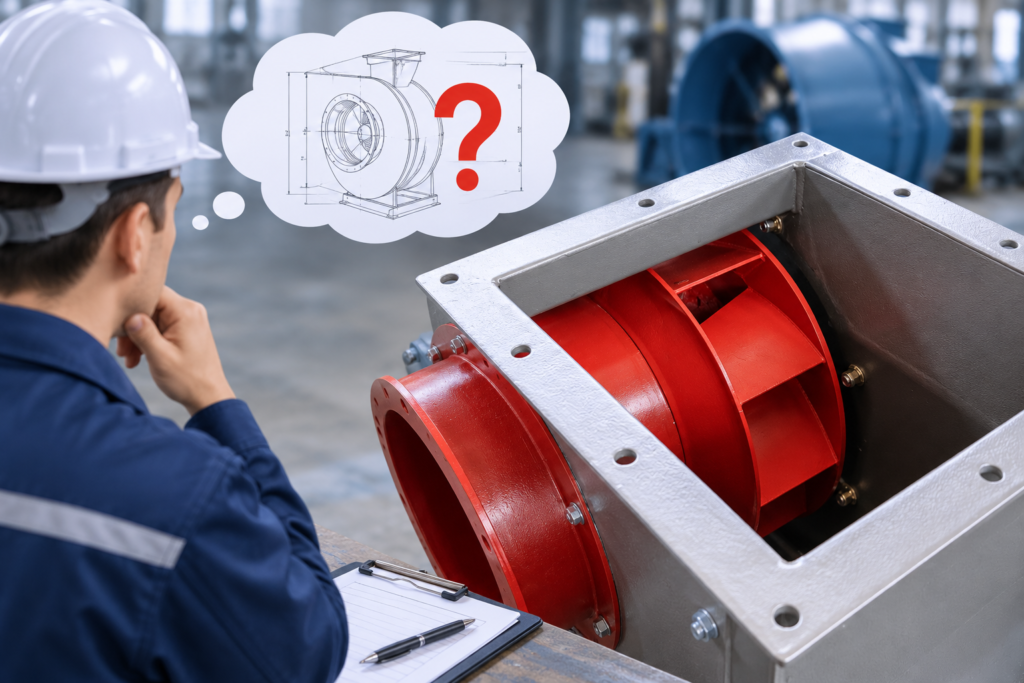
Replacing an industrial fan can become difficult when the original drawings, datasheet, or manufacturer information are no longer available. This is common in older plants, equipment upgrades, maintenance projects, and facilities where the original supplier cannot be contacted.
The main challenge is not simply finding a fan with similar dimensions. A replacement must be assessed against the required airflow, pressure, installation arrangement, motor and drive configuration, operating environment, and any applicable safety requirements.
This guide explains what information to collect, which measurements matter, and how to prepare a replacement fan RFQ that allows suppliers to evaluate the application more accurately.
1. Identify the Existing Fan Before Requesting a Replacement
Start by recording all available identification information. Even a partially readable nameplate, an old maintenance record, or a photograph of the installation may help narrow down the equipment type.
Record the following details wherever available:
- Manufacturer, model, serial number, and year of manufacture.
- Fan type, such as axial, centrifugal, induced-draft, forced-draft, or mine ventilation fan.
- Rated airflow, total or static pressure, and rotational speed.
- Motor power, voltage, frequency, current, and speed.
- Drive arrangement, including direct drive, belt drive, or coupling.
- Inlet and outlet dimensions, mounting arrangement, and installation orientation.
Photograph the complete fan, the motor nameplate, the fan nameplate, the inlet and outlet connections, the drive assembly, and the surrounding installation. Take close-up photographs of identification plates so that model numbers and electrical data can be read clearly.
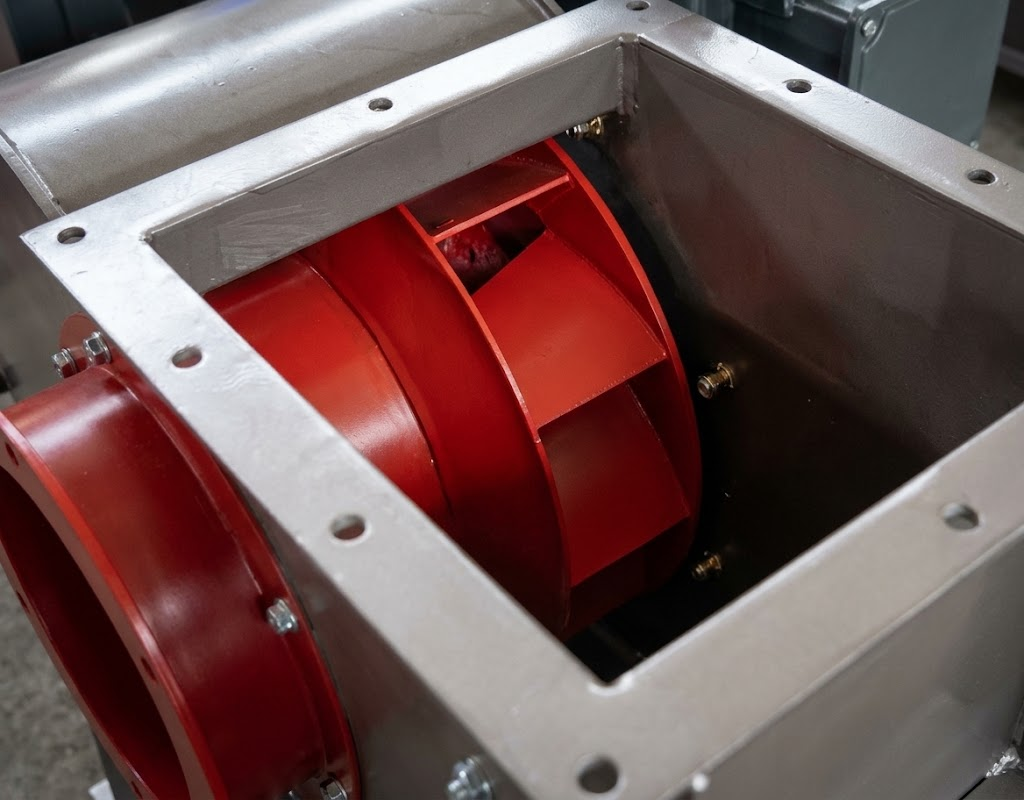
Important: motor power alone does not establish the fan’s required operating point. Two fans with the same motor rating may have different airflow, pressure, speed, and performance characteristics.
2. Measure the Installation Dimensions
When drawings are unavailable, take physical measurements before requesting a quotation. These measurements help determine whether a replacement can fit the existing installation or whether an adapter, transition, or structural modification may be required.
| Measurement | What to record | Why it matters |
|---|---|---|
| Inlet and outlet | Diameter or width × height, flange dimensions, and connection type | Checks compatibility with existing ductwork and connections |
| Mounting base | Hole spacing, base dimensions, and mounting orientation | Helps assess whether the replacement can use the existing foundation |
| Overall envelope | Length, width, height, and available clearance | Reduces the risk of installation interference |
| Shaft and drive | Shaft diameter where accessible, coupling or pulley details, and belt arrangement | Supports drive compatibility assessment |
| Orientation | Inlet and outlet direction, rotation direction, and motor position | Helps avoid incorrect installation or airflow direction |
For centrifugal fans, pay particular attention to the casing orientation, outlet angle, inlet arrangement, shaft position, and motor location. For axial fans, check the casing length, flange arrangement, mounting method, and the available space around the fan.
For reference, you can compare the installation arrangement with the relevant industrial axial fan or industrial centrifugal fan product range. A visual resemblance is useful for preliminary identification, but it does not confirm performance equivalence.
3. Establish the Required Airflow and Pressure
Airflow and pressure are among the most important parameters in replacement fan selection. If the original datasheet is missing, investigate whether the values can be recovered from process documents, commissioning reports, control-system records, previous quotations, or maintenance files.
Airflow
Record the required airflow and its units, such as m³/h, m³/s, or CFM. Confirm whether the value represents the design requirement, the original fan’s rated value, or a measured operating value.
Pressure
Record the required pressure in Pa, kPa, or another stated unit. Where possible, identify whether the specification refers to static pressure, fan total pressure, or another defined pressure basis.
These pressure terms are not automatically interchangeable. The supplier needs to understand the system and the measurement basis before comparing performance data.
System resistance and operating point
The required duty point depends on the complete air system, including ductwork, filters, dampers, heat exchangers, process equipment, and other resistance-producing components. Changes made to the system since the original fan was installed may affect the replacement selection.
If the original airflow and pressure cannot be confirmed, provide the supplier with the available process information and explain what is known and unknown. Do not treat a motor nameplate or casing size as a substitute for verified duty data.
For applications involving underground headings or mine duct systems, the selection may also require a review of duct resistance, leakage, operating mode, and airflow requirements. See the underground auxiliary ventilation fan selection guide for additional considerations specific to these systems.
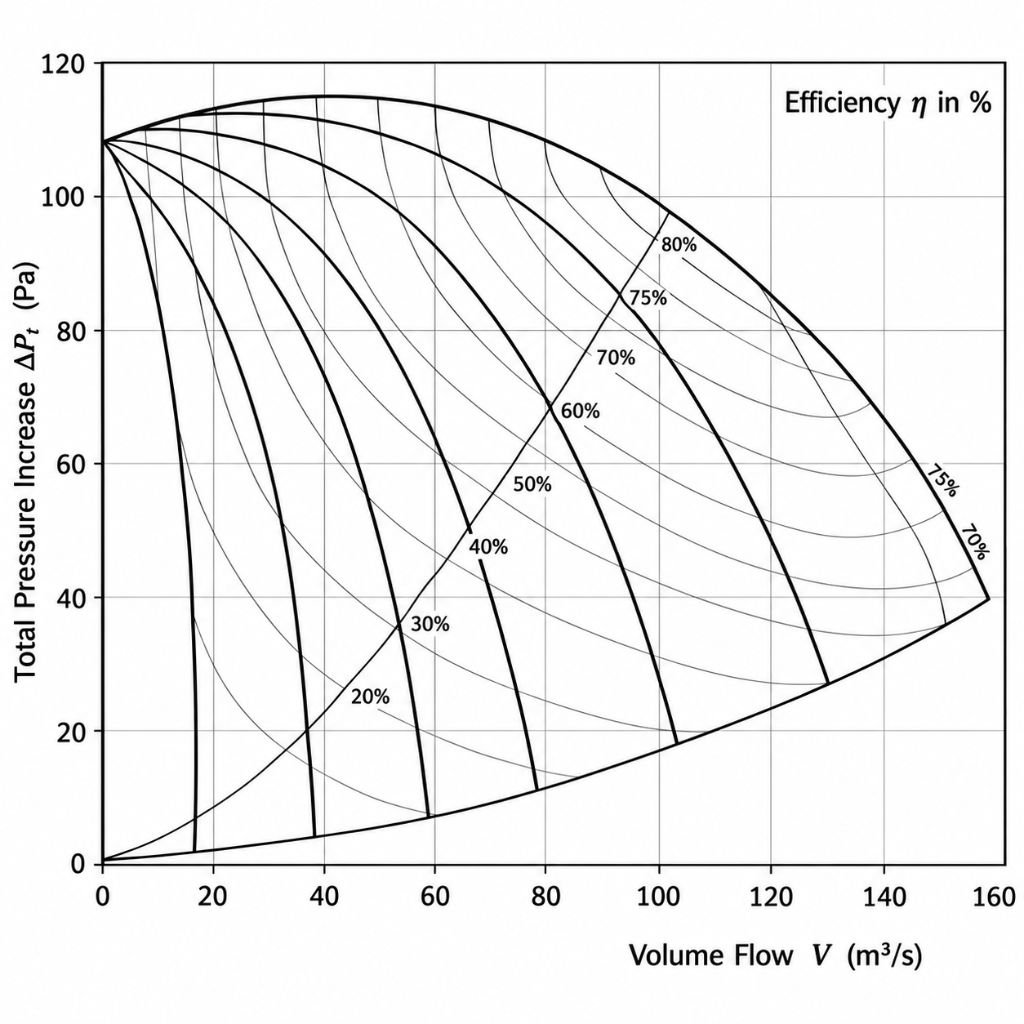
Engineering note: a replacement should be evaluated at the required operating point, not only by comparing maximum airflow, maximum pressure, or motor power independently.
4. Check the Motor and Drive Configuration
A mechanically compatible fan may still be unsuitable if its motor or drive arrangement does not match the installation or operating requirements.
Collect the following information:
- Motor rated power in kW or HP.
- Rated voltage, frequency, phase, current, and rotational speed.
- Motor protection rating and insulation class, if specified.
- Required efficiency class, if applicable.
- Direct-drive, belt-drive, or coupling arrangement.
- Variable-frequency drive (VFD) use and required operating speed range.
- Starting method, control requirements, and any specified electrical protection.
Do not assume that the existing motor rating is automatically appropriate for a replacement fan. The required power depends on the selected fan’s operating point and efficiency, as well as the application’s operating conditions.
Where a VFD is used, specify the required speed range and operating conditions. The supplier should assess whether the proposed motor and fan can operate appropriately across that range. Low-frequency operation should not be approved solely because a VFD is installed; motor cooling, torque, vibration, and fan performance may need to be checked.
5. Confirm Air Conditions and Operating Environment
The replacement fan must be suitable for the air being handled and the environment in which the equipment operates. These conditions can influence the casing, impeller, materials, motor selection, seals, and protective measures.
Include the following information in the inquiry:
- Air temperature: normal operating temperature and any maximum or minimum conditions.
- Air composition: clean air, dust-laden air, corrosive gases, moisture, or process-specific contaminants.
- Particle characteristics: dust concentration, particle size, abrasiveness, and any known buildup or blockage risks.
- Ambient conditions: indoor or outdoor installation, ambient temperature, humidity, and exposure to weather.
- Operating schedule: continuous duty, intermittent operation, frequent starts, or variable-load service.
- Special requirements: noise limits, corrosion resistance, hazardous-area requirements, or specified fire-related performance.
For abrasive or corrosive applications, material selection should be based on the actual operating conditions rather than a general label such as “industrial air.” If the fan handles hazardous gases, combustible dust, or air at elevated temperatures, identify these conditions clearly before the supplier proposes an equipment configuration.
6. Verify Rotation Direction, Airflow Direction, and Installation Orientation
Rotation and airflow direction are separate details and should be confirmed independently. Record the viewing direction used to identify rotation, and provide photographs or a simple sketch showing the inlet, outlet, motor location, and required airflow direction.
Also confirm whether the application requires reversible airflow, variable airflow, or a specific installation orientation. These functions should not be assumed to be available on every fan design.
Where the existing fan is connected to fixed ductwork or process equipment, check whether the replacement outlet direction and connection arrangement match the site layout. If they do not, identify the required modifications before finalizing the technical offer.
7. Identify Application-Specific and Compliance Requirements
Some replacement projects involve requirements beyond basic performance and dimensions. These should be identified at the inquiry stage because they may affect the fan design, motor, materials, documentation, and delivery scope.
- Mining applications: specify the underground location, ventilation duty, required airflow modes, and any applicable mine safety or equipment requirements. Review the relevant mine ventilation fan range as a starting point for product identification.
- Hazardous areas: state the required hazardous-area classification and the applicable certification or marking requirements. Do not assume an ordinary industrial motor is acceptable.
- High-temperature applications: define the actual gas temperature, required operating duration, and any specified fire or smoke-control standards.
- Corrosive or abrasive service: describe the medium and operating conditions so that casing and impeller materials can be assessed.
- Project documentation: list required drawings, performance curves, material information, test records, certificates, and inspection documents.
Applicable standards and certification requirements should be confirmed for the installation location and end use. A replacement fan should not be described as compliant until the relevant requirements have been reviewed and supported by appropriate documentation.
8. Decide Whether You Need a Like-for-Like Replacement or a Redesign
Once the available information has been collected, determine whether the project is intended to reproduce the existing equipment or improve the installation.
| Approach | When it may be suitable | Key point to verify |
|---|---|---|
| Like-for-like replacement | The existing fan’s duty and installation are understood, and the operating requirements remain unchanged. | Verify performance, dimensions, drive, materials, and interfaces. |
| Replacement with installation modifications | The original model is unavailable or the new fan has different dimensions or connections. | Confirm adapter requirements, structural changes, duct transitions, and site clearances. |
| Engineering redesign | Process conditions have changed, the existing fan is unsuitable, or performance problems need to be addressed. | Reassess the system duty, operating point, motor power, controls, and installation constraints. |
A replacement project should not automatically reproduce the original equipment if the original fan was poorly selected, the process has changed, or the existing system has been modified. Conversely, changing the fan design without confirming system requirements can introduce new performance or installation problems.
9. Prepare a Complete Replacement Fan RFQ
A well-structured request for quotation helps suppliers identify missing information early and reduces the risk of comparing offers that are based on different assumptions.
- Equipment name, existing model, manufacturer, and nameplate photographs.
- Required airflow and pressure, including the pressure basis where known.
- Existing fan speed, motor rating, voltage, frequency, and drive arrangement.
- Inlet and outlet dimensions, flange details, mounting dimensions, and overall clearance.
- Rotation direction, airflow direction, and installation orientation.
- Air temperature, medium, dust or corrosive characteristics, and ambient conditions.
- Operating schedule, control method, and any VFD requirements.
- Applicable safety, certification, and documentation requirements.
- Required quantity, delivery destination, target delivery date, and quotation currency.
- Photographs of the complete installation and any available drawings or maintenance records.
If some parameters are unknown, mark them as “not available” instead of estimating them without evidence. The supplier can then identify the information gaps and advise whether additional measurements, system data, or an engineering review are necessary.
10. How to Compare Replacement Fan Quotations
When comparing offers, check more than the quoted price and delivery time. Each supplier should state the proposed fan configuration and the basis on which it has been selected.
- Performance: confirm the proposed airflow and pressure at the required operating point.
- Motor and drive: check power, voltage, frequency, speed, control compatibility, and starting requirements.
- Mechanical fit: compare connection dimensions, mounting details, rotation, outlet orientation, and available space.
- Operating suitability: confirm air temperature, medium, materials, and environmental conditions.
- Scope of supply: identify whether the offer includes the motor, base, guards, flexible connectors, dampers, control panel, accessories, and required documentation.
- Deviations: require the supplier to list any differences from the original equipment or inquiry specification.
- Commercial terms: compare delivery time, packing, shipping terms, warranty, payment terms, and exclusions.
Where the original fan data is incomplete, ask the supplier to separate confirmed parameters from assumptions and recommendations. This makes technical approval more transparent and reduces the chance of an unsuitable replacement being ordered.
11. Common Mistakes to Avoid
Selecting by motor power alone
Motor power does not uniquely identify fan performance. Confirm the required airflow and pressure, and request the relevant performance information.
Matching only the external dimensions
A fan that fits the existing opening may still deliver insufficient airflow or pressure. Mechanical fit and aerodynamic suitability must be checked separately.
Ignoring system changes
New ductwork, filters, dampers, process equipment, or changed operating conditions can alter system resistance. Recheck the duty point if the installation has changed.
Assuming the original specification is still correct
The existing fan may have been selected for an earlier process configuration. Confirm whether the original operating requirements remain valid.
Leaving special conditions out of the inquiry
Temperature, dust, corrosion, hazardous-area requirements, and control conditions can affect equipment suitability. State them before a supplier finalizes its proposal.
12. Replacement Industrial Fan Support from GORNOVENT
GORNOVENT can review the available equipment information and help establish the technical details needed for a replacement fan inquiry. The starting point may be an existing model number, nameplate photograph, installation dimensions, operating data, or a description of the process.
If the original drawings are unavailable, provide whatever verified information you have. Any missing parameters can then be identified for further confirmation before a technical proposal is finalized.
For product identification, you can also review the relevant axial fan, centrifugal fan, and mine ventilation fan categories. For projects requiring a replacement-focused review, see replacement industrial fan solutions once the relevant page is available.
Request a Replacement Fan Assessment
Send us your existing fan information and operating requirements. Our team can review the available data, identify missing technical details, and assess the next steps for a replacement quotation.
Fan and motor nameplate photos, installation pictures, available dimensions, and required airflow and pressure.
Operating medium, temperature, electrical supply, drive arrangement, installation constraints, and any special requirements.
For a more accurate assessment, include the project location, required quantity, target delivery date, and any available technical documents. Final selection is subject to verification of the operating requirements and installation conditions.
Frequently Asked Questions
Can an industrial fan be replaced without the original drawings?
Yes, in many cases. The existing fan and motor nameplates, installation measurements, operating data, and photographs can provide a starting point. Additional system information may be required to confirm the replacement duty and mechanical interfaces.
Can I select a replacement fan using the existing motor power?
Not reliably. Motor power alone does not establish airflow, pressure, fan speed, or efficiency. The required operating point and the system conditions should be assessed before a replacement is selected.
What if the original airflow and pressure are unknown?
Check commissioning records, process documents, maintenance files, control-system data, and previous supplier quotations. If the values remain unknown, provide the available process information and identify the uncertainty so the supplier can determine what additional data is needed.
Does a replacement fan need to have exactly the same dimensions?
Not necessarily. Matching dimensions can simplify installation, but the replacement must also meet the required performance and operating conditions. If the dimensions differ, adapters or installation modifications may be needed.
What photographs are most useful for a replacement fan inquiry?
Provide clear photographs of the complete fan, fan nameplate, motor nameplate, inlet and outlet, mounting base, drive arrangement, and surrounding installation. Include a simple sketch with dimensions where possible.
What should a supplier include in a replacement fan quotation?
The quotation should identify the proposed fan and motor configuration, rated operating parameters, installation interfaces, scope of supply, delivery time, commercial terms, and any deviations or assumptions that require approval.

