

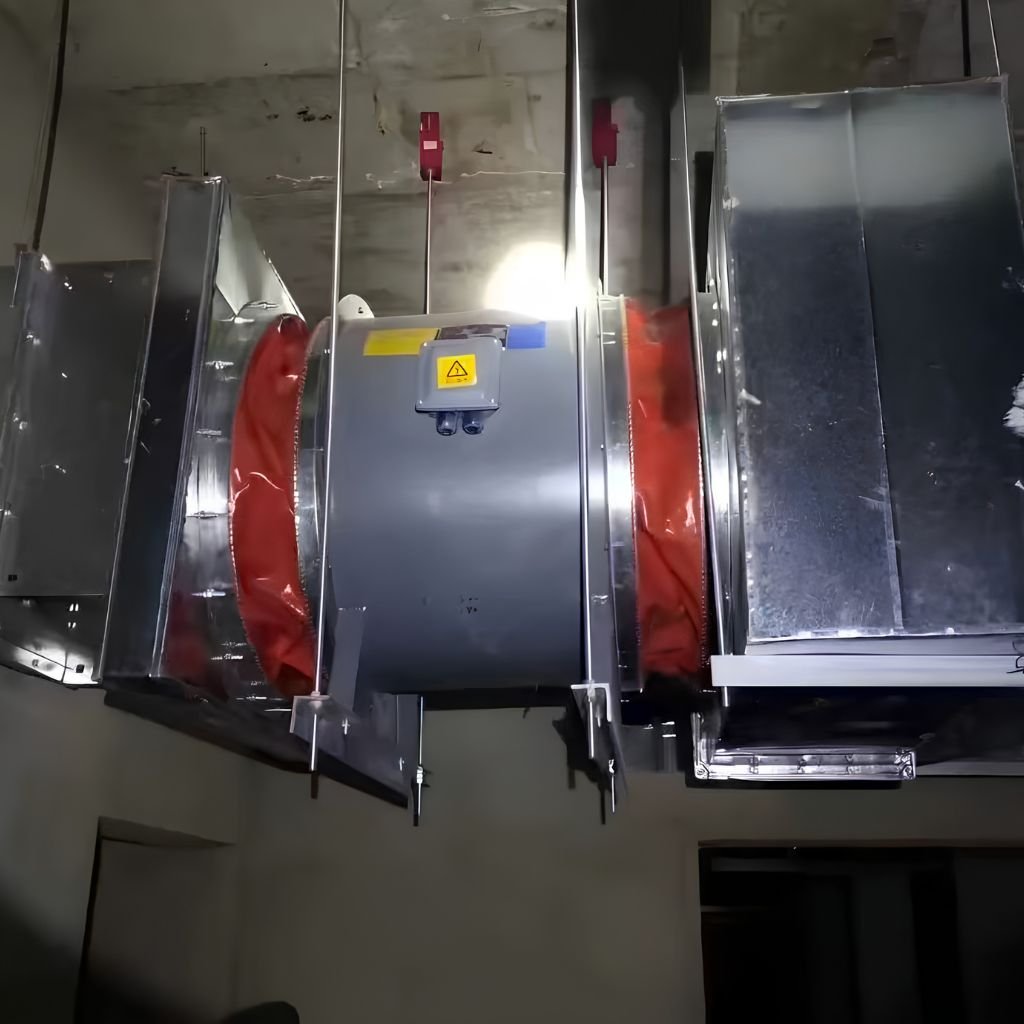
When an industrial fan runs but delivers less airflow than expected, the problem is not always the fan itself. The cause may be increased system resistance, a change in fan speed, an incorrect damper position, air leakage, a measurement issue, or a mismatch between the fan and the current operating requirements.
Replacing the fan before identifying the cause can lead to unnecessary cost and may not solve the problem. A more reliable approach is to verify the measured airflow, inspect the air system, check the fan’s operating condition, and compare the actual operating point with the design requirements.
This guide explains how to troubleshoot low airflow in industrial ventilation and process air systems, which parameters to check, and when the problem may require a new fan selection.
1. Confirm That the Airflow Is Actually Below Requirement
Before inspecting or adjusting the equipment, establish what “low airflow” means in the specific application. The required design airflow, the original commissioning result, and the current measured airflow are different types of information and should not be treated as interchangeable.
Collect the following data where available:
- Design airflow: the airflow specified for the process or ventilation system.
- Previous operating data: commissioning reports, historical measurements, or control-system records.
- Current airflow: the measured value, its units, the measurement location, and the method used.
- Operating conditions: fan speed, damper position, filter condition, process load, and other relevant equipment settings.
- Pressure readings: available inlet, outlet, or differential-pressure measurements, with the measurement locations identified.
Check whether the current measurement was taken under conditions comparable to the original design or commissioning conditions. For example, a fan operating at a different speed or against a different process load may not deliver the same airflow as before.
Also confirm that the measurement method is appropriate for the duct geometry and airflow conditions. A single reading at an unsuitable location may not accurately represent the average airflow through the system.
First diagnostic question: Is the airflow genuinely below the required value, or are the reference data, operating conditions, or measurement method different?
2. Check for Increased System Resistance
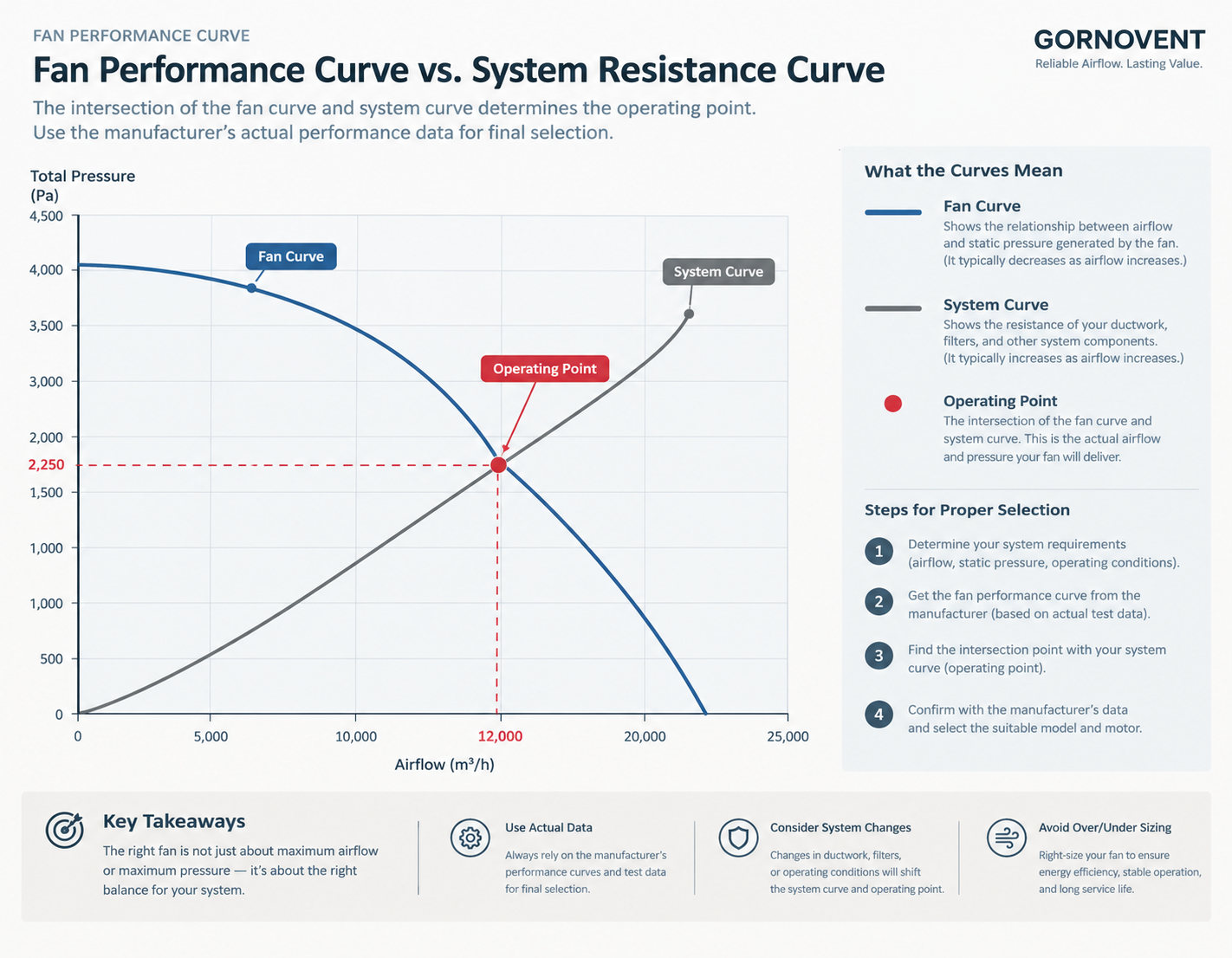
Increased system resistance is a common reason why an installed fan delivers less airflow than expected. The fan operates where its performance characteristics intersect with the resistance characteristics of the connected system. If the system becomes more restrictive, the operating point can shift to a lower airflow.
Inspect the components along the complete air path rather than examining the fan in isolation.
Blocked filters and restricted equipment
Dust-loaded filters, clogged screens, fouled heat exchangers, and restricted process equipment can increase pressure losses. Check filter differential pressure where measurement points are available, and compare the result with the equipment’s specified service limits.
Do not remove filters or bypass protective equipment as a routine diagnostic shortcut. Any inspection or maintenance must follow the site’s safety procedures and the equipment manufacturer’s requirements.
Duct restrictions and excessive resistance
Inspect the duct system for collapsed flexible sections, accumulated deposits, obstructions, damaged internal liners, closed access points, and unexpected restrictions. Sharp transitions, unsuitable duct dimensions, and changes in the system layout may also increase pressure losses.
Damper position
Verify that manual and automatic dampers are in their intended operating positions. A damper that has been partially closed, incorrectly adjusted, or commanded by a control system can restrict airflow.
Check the actual damper position rather than relying only on a control-system command. Where the system uses automatic control, review the relevant setpoints, feedback signals, and interlocks.
Changes to the system after commissioning
Additional duct branches, new filters, replacement process equipment, or changes to the number of operating outlets can alter the system’s resistance. If the airflow problem began after an installation change, compare the current configuration with the original design.
| Observation | Possible explanation | Next check |
|---|---|---|
| Filter differential pressure is higher than its normal or specified range | Filter loading or restriction | Inspect the filter and verify the maintenance requirement |
| A damper is not in its intended position | Flow restriction or control issue | Verify actuator movement, position feedback, and control settings |
| The system was modified before airflow decreased | Changed system resistance or distribution | Review the revised duct layout and process configuration |
| Airflow differs substantially between branches | Possible distribution imbalance or branch restriction | Compare branch conditions and balancing settings |
3. Check Fan Speed, Rotation, and Mechanical Condition
If system restrictions do not explain the problem, investigate whether the fan is operating as intended. A fan can appear to run normally while delivering less airflow because its speed, rotation, mechanical condition, or drive arrangement has changed.
Actual rotational speed
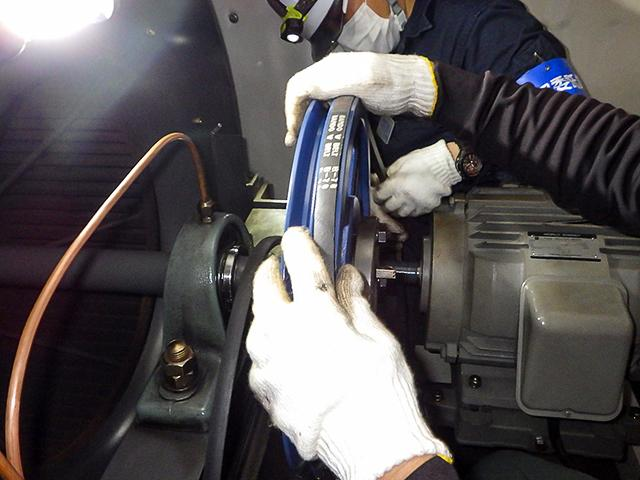
Compare the measured fan speed with the design or approved operating speed. For belt-driven equipment, inspect belt condition, tension, pulley condition, and the specified drive ratio. A slipping belt or incorrect pulley arrangement can reduce the fan speed.
For VFD-controlled fans, check the actual operating frequency and speed feedback, where available. Do not assume that the commanded frequency is the same as the actual shaft speed under all conditions.
Rotation direction
Verify the rotation direction against the manufacturer’s documentation and the specified viewing direction. Incorrect rotation can significantly affect the performance of some fan designs. The effect depends on the fan construction, and the correct rotation direction should not be inferred from appearance alone.
Any rotation check involving exposed rotating equipment must be performed by qualified personnel using the site’s isolation, guarding, and electrical safety procedures.
Impeller condition
Inspect for dust accumulation, deposits, erosion, corrosion, deformation, damage, or other changes that may affect the impeller’s aerodynamic performance. Deposits can alter the blade profile and increase imbalance; wear or damage may also affect the fan’s operating condition.
Where inspection requires opening the casing or accessing the impeller, isolate the equipment and follow the manufacturer’s maintenance procedure.
Drive and mechanical condition
Check for belt problems, coupling issues, abnormal bearing condition, shaft misalignment, and other mechanical faults. These problems do not all cause low airflow directly, but they can affect the fan’s speed, reliability, or ability to operate at the intended duty point.
If abnormal vibration, overheating, unusual noise, or signs of mechanical damage are present, investigate those conditions before continuing routine performance testing.
4. Check for Air Leakage and Incorrect Air Distribution
Air leakage can reduce the amount of air that reaches the intended process or ventilation point. However, the effect depends on where the leak occurs and how the system is configured.
Inspect accessible duct joints, flexible connectors, access doors, flange connections, and damaged duct sections. Where appropriate, use a suitable inspection method to identify leakage without exposing personnel to unsafe conditions.
Distinguish between two different questions:
- Fan airflow: how much air passes through the fan at the measurement point.
- Delivered airflow: how much air reaches the intended outlet, process, or working area.
These values may differ when leakage or unintended flow paths exist between the fan and the point of use. A fan may move a substantial amount of air while the intended process receives less than required.
In branched systems, check whether airflow is being distributed as intended. An open branch with low resistance may receive more flow than expected, while another branch may be starved of air. The appropriate remedy may involve balancing or system changes rather than replacing the fan.
5. Check Air Density and Operating Conditions
Air density affects fan performance and the relationship between volumetric flow, pressure, and power. Changes in air temperature, absolute pressure, or gas composition can therefore matter when comparing actual performance with a design specification.
Record the actual air conditions where they differ materially from the design basis. This is particularly relevant for high-temperature process air, installations at significant altitude, and systems handling gases other than ordinary ambient air.
When reviewing a performance curve, confirm the conditions and conventions under which the curve was generated. A comparison may be misleading if the design data and current operating data refer to different air conditions or different pressure definitions.
Do not assume that air density is the cause of low airflow simply because the process temperature has changed. Check the actual duty point, system conditions, and available measurements before drawing that conclusion.
6. Understand the Fan Operating Point
A fan’s airflow cannot be assessed independently of the system it serves. The operating point is established by the relationship between the fan’s performance curve and the system’s resistance curve under the relevant operating conditions.
If system resistance increases, the operating point may move toward lower airflow. If fan speed changes, the fan’s performance curve also changes. The precise result depends on the fan characteristics and the system.
What to verify on the performance curve
- The required airflow and corresponding pressure.
- Whether the stated pressure is static pressure or total pressure.
- The fan speed and air conditions associated with the curve.
- The expected power demand at the relevant operating point.
- Any stated operating limits or restrictions for the selected fan.
Do not compare only the maximum airflow of two fans. Maximum airflow may be specified at a pressure different from the required system duty. Similarly, a fan’s maximum pressure does not establish the airflow it can deliver at that pressure.
If the actual operating point cannot be confirmed from the available data, collect the relevant measurements and request a technical review. A supplier should identify the basis of the proposed selection and disclose any assumptions that remain unresolved.
For product identification, see the industrial axial fan range and the industrial centrifugal fan range. These categories can help narrow the equipment type, but final selection requires application-specific performance data.
7. Distinguish an Operating Problem from an Incorrect Fan Selection
After checking the measurement, system resistance, fan speed, mechanical condition, and operating environment, determine whether the fan is suitable for the current requirement.
The original fan may have been correctly selected for an earlier operating condition, while the process or ventilation system has since changed. Alternatively, the original selection may not have provided the required duty point in the first place.
| Finding | Likely next step |
|---|---|
| A blocked filter, closed damper, or duct restriction is identified | Correct the restriction according to the applicable maintenance or operating procedure, then remeasure performance. |
| Actual fan speed differs from the specified operating speed | Investigate the drive, control settings, and approved operating range. |
| Leakage or distribution imbalance is confirmed | Repair leakage or review the air distribution and balancing arrangement. |
| The system has changed since the original selection | Reassess system resistance and the required operating point. |
| The fan cannot meet the verified duty under the required conditions | Review the fan selection and assess whether a different configuration or replacement is necessary. |
| Available data is insufficient to determine the cause | Collect additional measurements and documentation before committing to a modification or replacement. |
Replacing a fan may be appropriate when the required operating point is outside the existing fan’s suitable operating range, the process requirements have changed, or the existing equipment is damaged or unsuitable. The decision should follow an engineering assessment rather than a general assumption that a larger motor or larger fan will solve the problem.
If the existing fan needs to be replaced and the original drawings are unavailable, use the replacement industrial fan specification guide to organize the nameplate information, installation measurements, and RFQ requirements.
8. A Practical Low-Airflow Troubleshooting Checklist
Use the following checklist to record findings before requesting maintenance support, a new selection, or a replacement quotation.
- Record the required airflow and the current measured airflow.
- Record the measurement location, method, units, and operating conditions.
- Record available inlet, outlet, or differential-pressure readings and their measurement locations.
- Confirm fan speed, operating frequency, and rotation direction against the applicable requirements.
System inspection
- Check filters, screens, dampers, ducts, and connected process equipment.
- Inspect accessible joints and connections for possible leakage.
- Review recent duct, process, or equipment modifications.
- Check whether airflow distribution across branches matches the intended arrangement.
Fan and motor inspection
- Record fan and motor nameplate details.
- Inspect the impeller and drive arrangement under safe, isolated conditions.
- Record abnormal vibration, noise, temperature, or visible damage.
- Compare available performance data with the actual operating point.
Information for technical review
- Photograph the complete fan, motor nameplate, and installation.
- Provide the available fan curve, system drawing, or process data.
- Describe when the airflow problem began and what changed beforehand.
- List any unresolved parameters instead of estimating them without evidence.
Safety note: electrical measurements, rotation checks, access to rotating components, and maintenance work should be performed by qualified personnel in accordance with site procedures and the equipment manufacturer’s instructions. Do not bypass guards or safety interlocks to investigate airflow problems.
9. What Information Should You Send to a Fan Supplier?
If the cause remains unclear or the existing fan may not meet the required duty, a structured technical inquiry can help establish the next step. Include both the original requirements and the current operating observations wherever possible.
- Fan type, model, manufacturer, and nameplate photographs.
- Required airflow, pressure, and pressure definition.
- Current measured airflow and any available pressure readings.
- Fan speed, motor power, voltage, frequency, and drive arrangement.
- Duct layout, inlet and outlet dimensions, dampers, filters, and other major system components.
- Air temperature, medium, dust or corrosive characteristics, and ambient conditions.
- Details of any recent system modifications or changes in process requirements.
- Required quantity, installation location, target delivery date, and project documentation requirements.
Where the existing data is incomplete, ask the supplier to distinguish confirmed information from assumptions. The supplier may need additional measurements or a system review before recommending adjustments or a replacement fan.
10. Frequently Asked Questions
Why is my industrial fan running but not moving enough air?
Possible causes include increased system resistance, a blocked filter, a restricted damper, reduced fan speed, incorrect rotation, leakage, changed operating conditions, or an unsuitable fan selection. Verify the measured airflow and investigate the system before deciding that the fan must be replaced.
Can a dirty filter reduce industrial fan airflow?
Yes. A loaded filter can increase pressure loss and shift the operating point, potentially reducing airflow. Check the filter condition and differential pressure where available, and follow the specified maintenance procedure.
Can incorrect fan rotation cause low airflow?
Yes, depending on the fan design. Incorrect rotation can significantly affect performance. Verify the rotation direction against the manufacturer’s documentation and use qualified personnel for any required inspection.
Will installing a larger motor increase airflow?
Not necessarily. A larger motor does not automatically change the fan’s aerodynamic characteristics or guarantee the required airflow. The fan curve, system resistance, speed, and operating limits must be assessed before any change is made.
Should I replace the fan if airflow is below the design value?
Not before identifying the cause. A blocked filter, incorrect setting, duct restriction, or leakage may be responsible. If the system is operating correctly but the fan cannot meet the verified duty, a new fan selection or replacement assessment may be justified.
What is the difference between low fan airflow and low delivered airflow?
Fan airflow refers to the air passing through the fan at a specified measurement point. Delivered airflow refers to the air reaching the intended outlet or process. Leakage, branch imbalance, or unintended flow paths can cause the delivered airflow to be lower than expected.
What data is needed to troubleshoot low airflow remotely?
Useful information includes the fan and motor nameplates, required and measured airflow, available pressure readings, operating speed, system layout, photographs, and a description of recent changes. Additional on-site measurements may be necessary if the cause cannot be established from the available information.
Need Help Assessing an Industrial Fan Airflow Problem?
If your industrial fan is not delivering the required airflow, send GORNOVENT the available equipment details and operating data. This information can help establish whether the next step is further measurement, a system review, or an assessment of replacement fan options.
Fan and motor nameplates, model number, photographs, and available performance curves.
Required and measured airflow, pressure readings, fan speed, air conditions, and recent system changes.
Please include the project location, required quantity if replacement is being considered, and any applicable technical or certification requirements. Final recommendations depend on the available data and verification of the actual operating conditions.

