
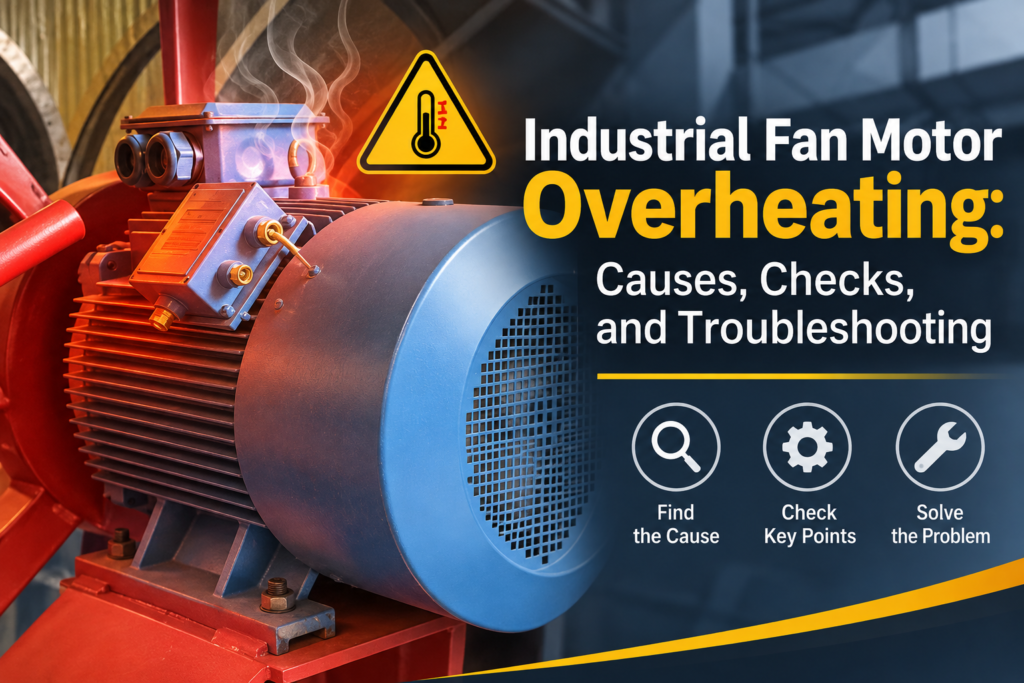
An industrial fan motor that runs unusually hot may be experiencing an electrical problem, excessive mechanical load, inadequate cooling, or an operating condition outside its intended duty. Before replacing the motor, it is important to identify what is causing the temperature rise and whether the problem originates in the motor, the fan, or the connected ventilation system.
Motor overheating should not be diagnosed by touch alone. The measured temperature must be evaluated against the motor manufacturer’s specifications, ambient conditions, insulation system, and actual operating duty. A warm motor housing does not necessarily indicate a fault, while a motor that continues running may still be operating outside its permitted limits.
The most common causes of industrial fan motor overheating are:
- Electrical problems: voltage imbalance, incorrect voltage, loose connections, or phase failure.
- Motor overload: excessive electrical or mechanical load under actual operating conditions.
- Cooling problems: blocked ventilation passages, contaminated cooling surfaces, or insufficient cooling airflow.
- Mechanical resistance: bearing deterioration, misalignment, impeller rubbing, or transmission problems.
- Fan operating conditions: changes in fan speed, airflow, pressure, air density, or system resistance.
The correct troubleshooting method is to check electrical measurements, mechanical condition, cooling arrangements, and the actual fan operating point before deciding whether the motor needs repair, replacement, or resizing.
1. How to Identify an Industrial Fan Motor Overheating Problem
The first step is to establish when the motor becomes hot and whether other operating symptoms appear at the same time. The timing of the temperature rise can help narrow down the possible causes.
| Observed condition | Possible causes | What to investigate |
|---|---|---|
| Motor becomes hot shortly after startup | Electrical supply problems, excessive starting load, mechanical binding, or incorrect connection | Starting behavior, supply voltage, current, protection records, and mechanical condition |
| Motor temperature gradually increases during operation | Overload, inadequate cooling, high ambient temperature, or unsuitable duty | Current trend, temperature trend, operating duration, and ventilation conditions |
| Motor overheats with abnormal noise or vibration | Bearing deterioration, misalignment, imbalance, or rotating component contact | Bearing condition, vibration trend, alignment, and impeller clearance |
| Motor protection trips repeatedly | Overcurrent, voltage imbalance, phase failure, or excessive load | Trip records, three-phase voltage and current, and protection settings |
| Motor overheats after duct or damper modifications | Changed system resistance and fan operating conditions | Actual airflow, pressure, fan speed, damper position, and motor current |
These symptoms are diagnostic clues rather than definitive fault identifications. Different problems can produce similar symptoms, so measurements and inspection are necessary before deciding on corrective action.
2. Electrical Causes of Industrial Fan Motor Overheating
2.1 Incorrect voltage or three-phase voltage imbalance
An electric motor is designed to operate within a specified voltage and frequency range. Incorrect supply voltage can affect motor current, magnetic flux, torque, and winding temperature.
For three-phase industrial fan motors, voltage imbalance is particularly important. Even a relatively small imbalance in supply voltage can result in a greater imbalance in phase currents, increasing winding losses and potentially causing excessive heating.
During an electrical inspection, qualified personnel should check:
- Line-to-line voltage at the motor terminals under operating conditions.
- Voltage balance across all three phases.
- Current on each phase and any abnormal current imbalance.
- Loose terminals, damaged cables, and overheated electrical connections.
- Whether the supply frequency matches the motor nameplate.
- Whether the motor terminal connections match the nameplate diagram.
A nominal supply voltage that matches the motor nameplate does not automatically mean that the actual supply is satisfactory. Measurements should be taken under the relevant operating load.
2.2 Excessive motor current and overload
Motor current is one of the most useful indicators when investigating overheating. Compare the measured current on each phase with the rated current shown on the motor nameplate and the manufacturer’s operating limits.
If the motor consistently draws more current than expected, possible causes include:
- Excessive mechanical resistance in the fan or transmission.
- Incorrect fan speed or an unsuitable drive configuration.
- Changes in the actual fan operating point.
- Electrical supply problems.
- Incorrect motor selection for the required duty.
Do not simply increase the overload protection setting when a motor trips repeatedly. The protection device may be responding to a genuine electrical or mechanical problem. The cause must be identified before any protection setting is changed.
2.3 Variable-frequency drive operation
Industrial fans operating with a variable-frequency drive (VFD) require additional attention. When motor speed is reduced, the cooling performance of a shaft-mounted cooling fan may also decrease.
A motor operating continuously at low speed under substantial torque may therefore experience inadequate cooling, depending on its design and cooling arrangement.
Check the following:
- Whether the motor is suitable for the intended VFD operating range.
- Whether the required torque can be maintained at the operating frequency.
- Whether the motor has independent or forced cooling.
- Whether the VFD motor parameters and protection settings are correct.
- Whether the drive manufacturer’s requirements for cable length, switching, and motor protection have been followed.
3. Mechanical Problems That Can Cause Motor Overheating
A motor may become excessively hot because it is required to overcome abnormal mechanical resistance. In such cases, replacing the motor without correcting the mechanical problem may not solve the overheating issue.
3.1 Bearing deterioration and lubrication problems
Bearings support the rotating shaft and help maintain smooth operation. Bearing deterioration, contamination, incorrect lubrication, or unsuitable installation can increase friction and operating temperature.
Inspection should consider:
- Abnormal bearing noise or changes in vibration.
- Incorrect lubricant type or lubrication quantity.
- Contamination from dust, moisture, or process materials.
- Incorrect bearing installation or excessive mechanical loading.
- Changes in bearing temperature compared with the normal operating baseline.
Bearing temperature should be evaluated according to the bearing and motor manufacturer’s specifications. A hot bearing area may indicate a local mechanical problem rather than an electrical fault in the motor windings.
3.2 Misalignment and transmission problems
For belt-driven industrial fans, incorrect belt tension, pulley misalignment, or damaged belts can increase mechanical losses and affect motor loading.
For directly coupled fans, coupling misalignment, mounting problems, and abnormal shaft movement should be investigated.
The fan impeller should also be checked for rubbing against the casing, foreign material, or damaged rotating components. Such problems can create additional resistance and cause the motor to draw more power than expected.
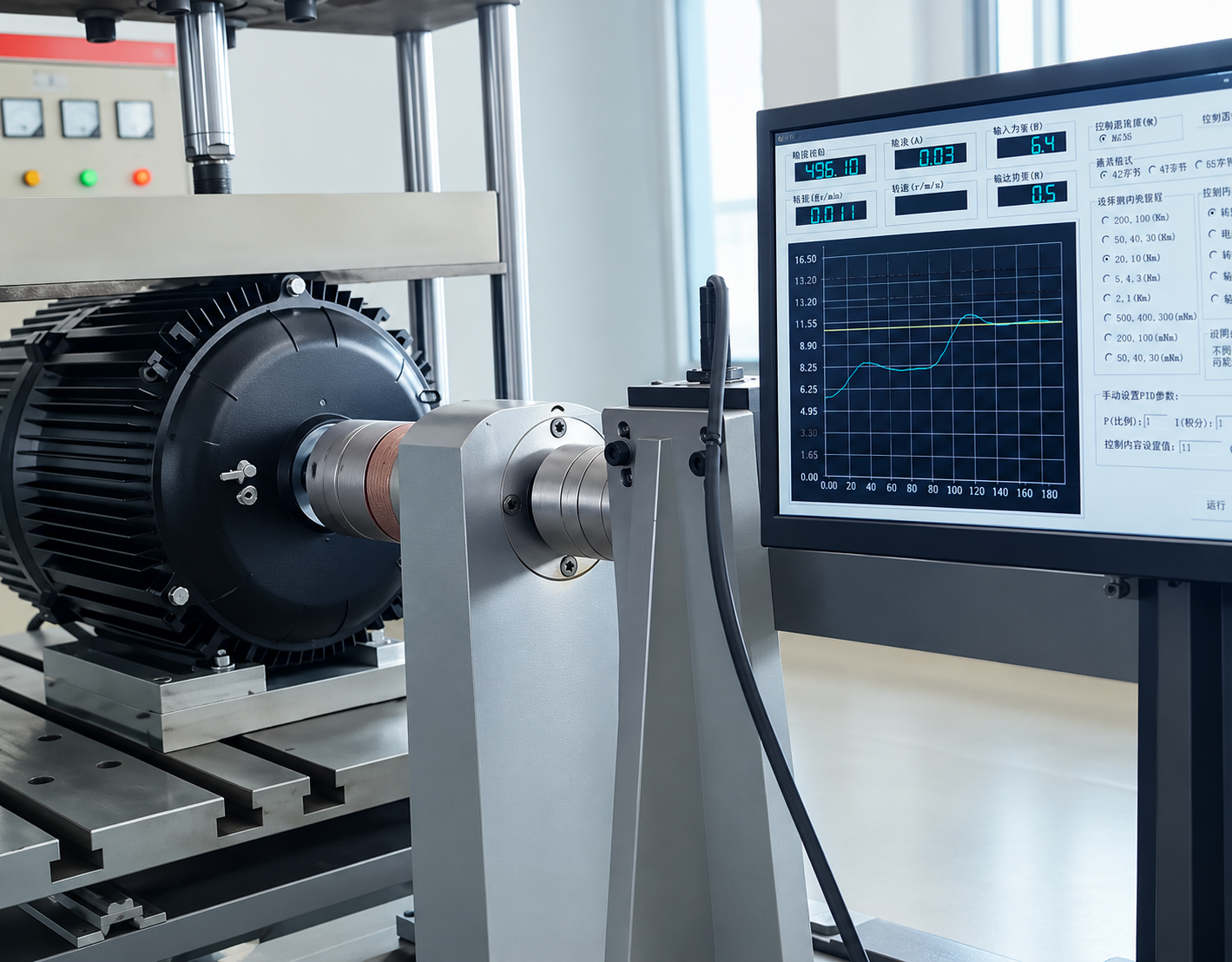
4. Inadequate Motor Cooling and Environmental Conditions
Even when the electrical supply and mechanical load appear normal, inadequate heat dissipation can cause an industrial motor to operate at excessive temperature.
4.1 Blocked cooling passages and contaminated surfaces
Dust, fibers, oil deposits, and other industrial contaminants can accumulate on motor cooling surfaces or restrict the ventilation path. This reduces the motor’s ability to release heat.
Check whether:
- Motor cooling-air inlets and outlets are unobstructed.
- Cooling fins are free from excessive dust or deposits.
- The motor’s external cooling fan and protective cover are intact.
- The installation provides the clearances required by the motor manufacturer.
- Nearby equipment is not obstructing cooling airflow.
4.2 High ambient temperature and demanding operating conditions
Motor temperature limits are based on specified operating conditions. Elevated ambient temperature, frequent starts, continuous operation, restricted ventilation, and demanding duty cycles can affect the thermal condition of a motor.
For motors installed in dusty, humid, corrosive, or potentially explosive environments, the enclosure, cooling arrangement, protection level, and applicable certification must be suitable for the actual installation.
A motor’s IP rating alone does not establish its suitability for every environmental or hazardous-area requirement. The complete motor specification and applicable approval documents should be checked.
5. Can Fan Operating Conditions Cause Motor Overheating?
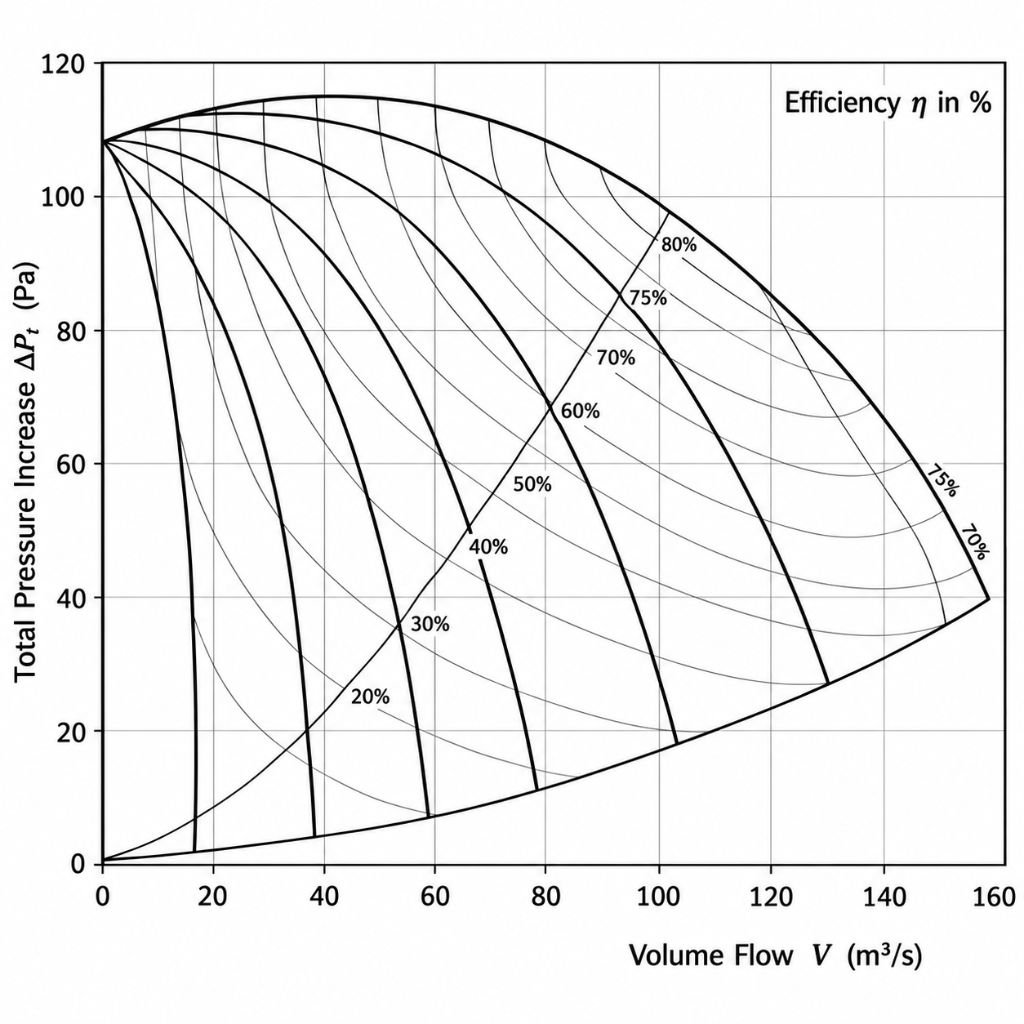
Yes. The motor and fan should be assessed as one operating system. Fan power demand depends on the fan design, speed, air density, and operating point. The operating point is determined by the fan performance characteristics and the resistance of the connected system.
5.1 Changes in airflow and system resistance
Changes to ductwork, filters, dampers, process equipment, or ventilation requirements can change system resistance and move the fan to a different operating point.
However, a reduction in airflow does not automatically mean that motor power will increase. The relationship between airflow and power depends on the fan’s design and its performance curve.
For this reason, the actual airflow and pressure should be measured and compared with the original fan selection data whenever possible.
5.2 Fan speed and impeller modifications
Changing the fan speed or impeller configuration can significantly affect the required shaft power.
For a geometrically unchanged fan operating under comparable conditions, the affinity laws provide a useful approximation:
- Airflow is approximately proportional to rotational speed.
- Pressure is approximately proportional to the square of rotational speed.
- Power is approximately proportional to the cube of rotational speed.
These relationships are useful for preliminary comparisons, but they are not a substitute for checking the actual fan performance curve and operating conditions. Changes in air density, system resistance, and operating range can affect the result.
5.3 Centrifugal and axial fans have different power characteristics
The relationship between airflow and motor power is not identical for all fan types. Different centrifugal impeller designs can have different power curves, while axial fans may be sensitive to operation near stall or other unstable regions.
A motor that is suitable for one fan design or operating point may not be suitable for another. When investigating overheating, confirm the actual fan model, impeller configuration, rotational speed, airflow, and pressure.
If your equipment is also experiencing insufficient airflow, see our related guide: Industrial Fan Low Airflow: Causes and Troubleshooting.
6. Industrial Fan Motor Overheating: A Practical Troubleshooting Checklist
A structured inspection helps distinguish electrical, mechanical, cooling, and fan-system problems. The following sequence can be used as a starting point for a qualified maintenance investigation.
- Record the symptoms. Document when the temperature rises, whether protection trips, and whether there are changes in noise, vibration, airflow, or process conditions.
- Check the motor nameplate. Record rated power, voltage, current, frequency, speed, duty, insulation class, and available temperature information.
- Measure electrical conditions. Have qualified personnel check three-phase voltage and current under the relevant operating load, and review protection records.
- Inspect the cooling arrangement. Check cooling passages, contamination, ambient temperature, and installation clearances.
- Inspect mechanical components. Following the required isolation procedure, examine bearings, alignment, belts or couplings, shaft movement, and impeller clearance.
- Verify the fan operating point. Compare actual airflow, pressure, speed, and air conditions with the original design requirements and available performance data.
- Identify the root cause before replacement. Determine whether the problem is caused by the motor, the fan, the drive arrangement, or the connected system.
7. Should You Repair, Replace, or Resize the Motor?
The correct solution depends on the confirmed fault and the required operating duty. Replacing a motor should not be the first response to every overheating problem.
| Inspection finding | Possible corrective action | Information to verify |
|---|---|---|
| Restricted cooling or contaminated surfaces | Restore the specified cooling path and maintenance condition | Motor cooling design, installation, and environmental conditions |
| Electrical supply or connection fault | Correct the supply or connection problem | Voltage, phase current, electrical connections, and protection records |
| Bearing damage or mechanical resistance | Repair the mechanical fault and verify operation | Bearing condition, alignment, clearances, and rotating components |
| Confirmed winding or insulation damage | Evaluate professional motor repair or replacement | Electrical test results, motor condition, and repair feasibility |
| Motor unsuitable for the verified fan duty | Review motor sizing and the complete fan selection | Airflow, pressure, fan curve, speed, air density, and operating duty |
Installing a larger motor does not automatically solve an overheating problem. If the actual cause is bearing friction, incorrect voltage, restricted cooling, or an unsuitable operating configuration, the same underlying problem may remain.
If the required fan duty has changed, however, a revised motor selection may be necessary. This should be based on the verified fan shaft power requirement, starting conditions, service duty, and applicable motor selection criteria.
8. Information Required for an Industrial Fan Motor Assessment
When the cause of overheating cannot be confirmed on site, providing complete technical information can help a fan supplier or motor specialist assess the equipment more efficiently.
Equipment information
- Fan nameplate and motor nameplate photographs.
- Fan model, motor model, rated power, voltage, frequency, and speed.
- Motor rated current and available duty information.
- Fan impeller arrangement and drive type.
- Available drawings and fan performance curves.
Operating information
- Measured motor temperature and measurement location.
- Measured current on each phase and supply voltage.
- Required and actual airflow and pressure, if available.
- Fan speed and VFD operating frequency, where applicable.
- Ambient temperature and conveyed-air conditions.
- Operating duration and the time required for the motor to become hot.
- Any recent changes to ductwork, filters, dampers, impeller, motor, or process conditions.
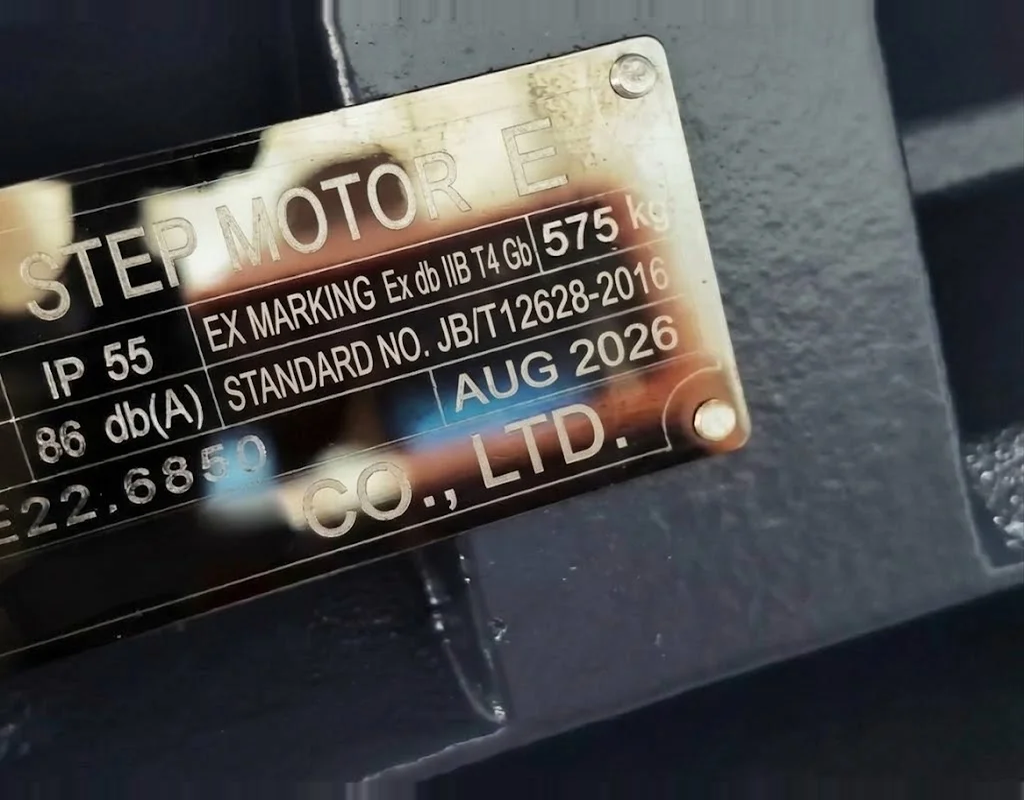
If the original fan drawings are unavailable, the equipment may still be assessed using its nameplate information, installation dimensions, operating data, and verified duty requirements. For more information, see: How to Specify a Replacement Industrial Fan Without the Original Drawings.
9. Frequently Asked Questions About Industrial Fan Motor Overheating
Why does my industrial fan motor get hot but continue running?
Possible causes include excessive load, inadequate cooling, elevated ambient temperature, voltage imbalance, bearing problems, or unsuitable operating conditions. Continued operation does not prove that the motor is within its permitted temperature limits. Compare measured conditions with the manufacturer’s specifications and investigate the root cause.
Can an industrial fan motor overheat if its current is below the nameplate rating?
Yes. Cooling problems, high ambient temperature, unsuitable variable-speed operation, and other conditions may contribute to overheating even when measured current is below the rated value. Current is an important diagnostic measurement, but it is not a complete assessment of motor temperature or condition.
Does low airflow cause an industrial fan motor to overheat?
Not necessarily. The relationship between airflow and motor power depends on the fan design, speed, system resistance, and operating point. Low airflow can indicate a system problem, but it does not by itself prove that the motor is overloaded. Check the fan performance curve and actual operating conditions.
Should I install a larger motor if the existing motor overheats?
Not before identifying the cause. A larger motor may be appropriate if the verified duty requires more power, but it will not automatically correct electrical supply problems, bearing damage, restricted cooling, or incorrect fan operation. Review the complete fan and motor duty before resizing.
Can a variable-frequency drive cause motor overheating?
It can contribute under certain conditions, particularly if the motor operates at low speed without adequate cooling or outside its permitted operating range. Check the motor’s suitability for VFD operation, the required torque, cooling arrangement, drive settings, and manufacturer limitations.
What information is needed to evaluate a replacement industrial fan motor?
Start with the motor and fan nameplates, rated power, voltage, current, frequency, speed, required airflow and pressure, drive type, operating environment, and reason for replacement. For a complete fan replacement, also provide installation dimensions, airflow direction, rotation requirements, and available performance data.
Conclusion
Industrial fan motor overheating should be treated as a symptom that requires diagnosis, not as proof that the motor needs immediate replacement. Electrical supply, mechanical resistance, cooling conditions, and the actual fan operating point all need to be considered.
A systematic investigation helps distinguish a motor fault from a fan or system problem. Where the existing equipment no longer meets the required duty, the fan and motor should be reviewed together to ensure that the proposed replacement matches the real operating conditions.
Need Help Assessing an Industrial Fan Motor Overheating Problem?
If your industrial fan motor is overheating, send GORNOVENT the available equipment details and operating data. This information can help determine whether the issue may involve the motor, fan operating conditions, mechanical components, or the connected ventilation system.
Fan and motor nameplates, model numbers, rated power, voltage, current, frequency, speed, and available performance curves.
Measured motor current and temperature, required airflow and pressure, fan speed, ambient conditions, drive type, and recent equipment or system changes.
Please include the project location, operating environment, and any applicable technical or certification requirements. Do not open or inspect energized equipment. Final recommendations depend on the available technical data and verification of the actual operating conditions.

