
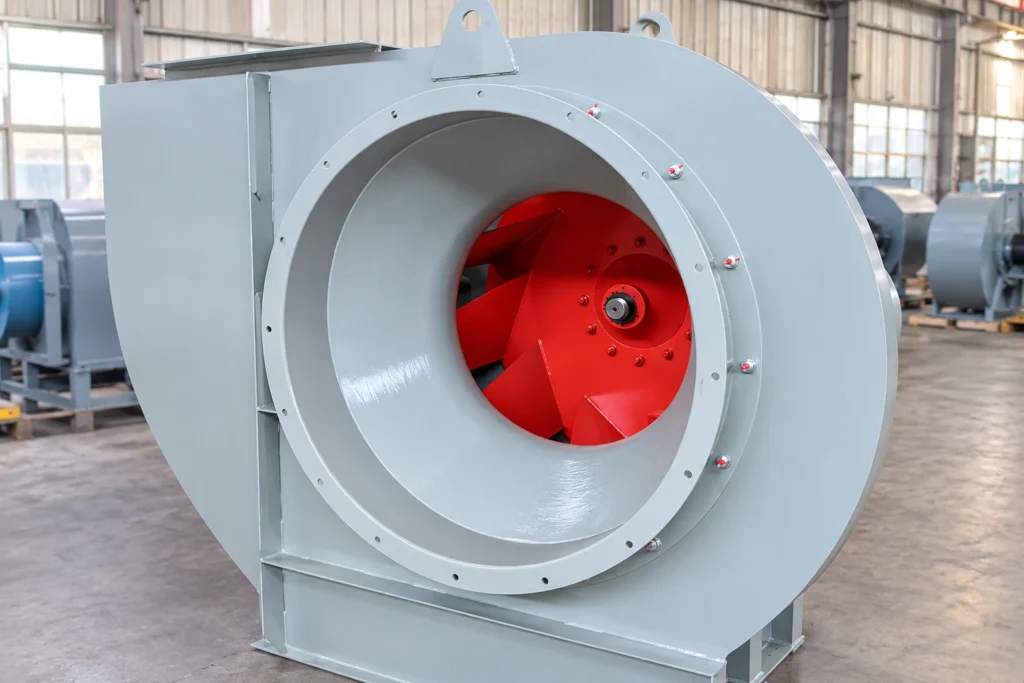
Standard carbon-steel industrial fans designed for clean, ambient air fail rapidly when exposed to elevated flue gas temperatures, corrosive chemical vapors, or flammable gas and dust mixtures. Selecting the right equipment for harsh industrial service goes well beyond matching airflow and static pressure—it requires coordinating wetted-part metallurgy, mechanical drive isolation, shaft sealing, and hazardous-area compliance.
This engineering guide explains how to specify high-temperature, explosion-proof, and corrosion-resistant industrial fans, highlighting material boundaries, international construction standards, and common specification conflicts when two or more harsh conditions occur together.
Quick Answer: How Do You Specify an Industrial Fan for Harsh Conditions?
For high-temperature gas, assess gas temperature, exposure time, wheel speed, shaft heat transfer, bearing arrangement, and thermal expansion—isolating the motor and bearings from the hot airstream and adding a shaft cooling wheel or bearing cooling where the design requires it. For corrosive fumes, select wetted materials and seals only after verifying the exact chemical composition, concentration, moisture, and temperature. For explosive atmospheres, evaluate the complete fan assembly against site hazardous-area rules; a certified motor alone is not sufficient—mechanical spark-resistant construction, electrical bonding, grounding, and surface-temperature control may also be required.
Important: Temperature and chemical limits depend on impeller tip speed, gas concentration, moisture dew point, and applicable hazardous-area regulations. Confirm final material grades and certifications against the project datasheet before ordering.
1. Why Standard Industrial Fans Fail in Harsh Duty
Standard general-purpose ventilation fans are engineered around clean air near 20°C, mild carbon steel construction, standard shaft clearances, and ordinary totally enclosed motors. Introducing heat, aggressive chemicals, or flammable atmospheres changes the failure mode completely:
Elevated heat lowers steel yield strength, breaks down bearing grease, causes thermal expansion and impeller rub, and creates severe motor overload risk during cold startups.
Unprotected carbon steel and unsuitable stainless grades suffer pitting, stress-corrosion cracking, and uneven blade thinning—leading rapidly to rotor imbalance and casing leaks.
Electrical arcs, hot bearing surfaces, electrostatic belt discharge, or metal-on-metal rubbing inside the fan scroll can ignite flammable gases, vapors, or combustible dusts.
Both axial and centrifugal fans can be engineered for demanding service. The preferred arrangement depends on airflow, pressure, gas properties, temperature, installation space, and whether the motor and bearings can be isolated from the process stream. A centrifugal layout may simplify some outboard-drive arrangements, while purpose-designed axial fans can also separate the motor from the airstream. For a baseline comparison of fan types, see our Axial Fan vs. Centrifugal Fan guide.
2. High-Temperature Industrial Fan Design & Material Limits
As airstream temperature increases, a fan’s mechanical configuration changes in stages. Steel loses allowable working stress as temperature rises, meaning maximum safe impeller tip speed decreases with heat. At the same time, heat conducted along the fan shaft must be prevented from overheating the bearings and drive motor.
| Typical Gas Temperature Band | Common Material Options | Drive & Cooling Arrangement | Key Mechanical Provisions |
|---|---|---|---|
| Up to ~80°C (Standard duty) |
Carbon steel (Q235 / A36) with industrial paint | Direct drive or belt drive; motor may sit in or out of airstream depending on design | Standard grease-lubricated bearings and normal running clearances. |
| ~80°C to 250°C (Medium-high temp) |
Carbon steel or a suitable stainless / heat-resistant alloy, selected by stress, oxidation, and process chemistry. Q355 is a structural steel grade, not a corrosion-resistant upgrade. | Motor isolated outside airstream (belt drive or coupling drive) + shaft cooling wheel (heat slinger) | High-temperature bearing grease, insulated shaft guard, increased impeller-to-inlet clearance. |
| ~250°C to 450°C (High temp — ovens, boilers, kilns) |
Suitable carbon or alloy steel and heat-resistant stainless grades, selected by strength, oxidation, corrosion, and calculated stress at operating temperature. | Outboard pillow-block bearings with heat slinger, oil-bath or water-cooled bearing housing where required | Flexible inlet/outlet expansion joints, insulated casing, thermal growth allowance during shaft alignment. |
| Above ~450°C (Severe thermal duty) |
Heat-resistant stainless steels (e.g., 309S / 310S) or nickel-base alloys, subject to process-specific material review. | Centerline-supported casing, heavy-duty water-cooled or forced-lubrication bearings, flexible coupling | Continuous weld stress design, controlled heat-up/cool-down ramp rates, special rotor clearance engineering. |
Engineering Note: Temperature thresholds above are general engineering reference ranges—not fixed structural limits. Actual maximum temperature depends on wheel diameter, RPM (tip speed), alloy grade, intermittent vs. continuous duty, and manufacturer stress calculations.
2.1 Cold-Startup Power Surge & Thermal Expansion
Critical Field Risk: Sizing the Motor for Cold Air vs. Hot Gas
At constant rotational speed and volumetric flow, fan pressure and shaft power are approximately proportional to gas density. As a simplified comparison using standard dry-air densities at sea level (approximately 0.67 kg/m³ at 250°C vs. 1.20 kg/m³ at 20°C), the density ratio is about 1.79—indicating a potential increase of roughly 79% in the density-related power component if started cold under the same volumetric conditions. Actual startup load depends on the fan curve, system resistance, damper position, and speed; verify it with the manufacturer rather than applying a fixed percentage universally.
To avoid overload trips, check the cold-start operating point against the fan curve and motor rating. Motor sizing, VFD ramping, and any closed-damper startup sequence must follow the fan manufacturer’s instructions and the system design; a closed-damper start is not suitable for every fan or process. For calculation details, review our industrial fan performance curve and air density guide and industrial fan motor overheating guide.
Thermal expansion must also be managed at the ductwork and coupling. Connecting rigid hot ducts directly to a fan casing without flexible expansion joints transmits heavy pipe strain into the housing, distorting bearing alignment and triggering severe vibration. Always confirm thermal growth offsets during installation and commissioning.
3. Corrosion-Resistant Industrial Fans: Material & Sealing Guide
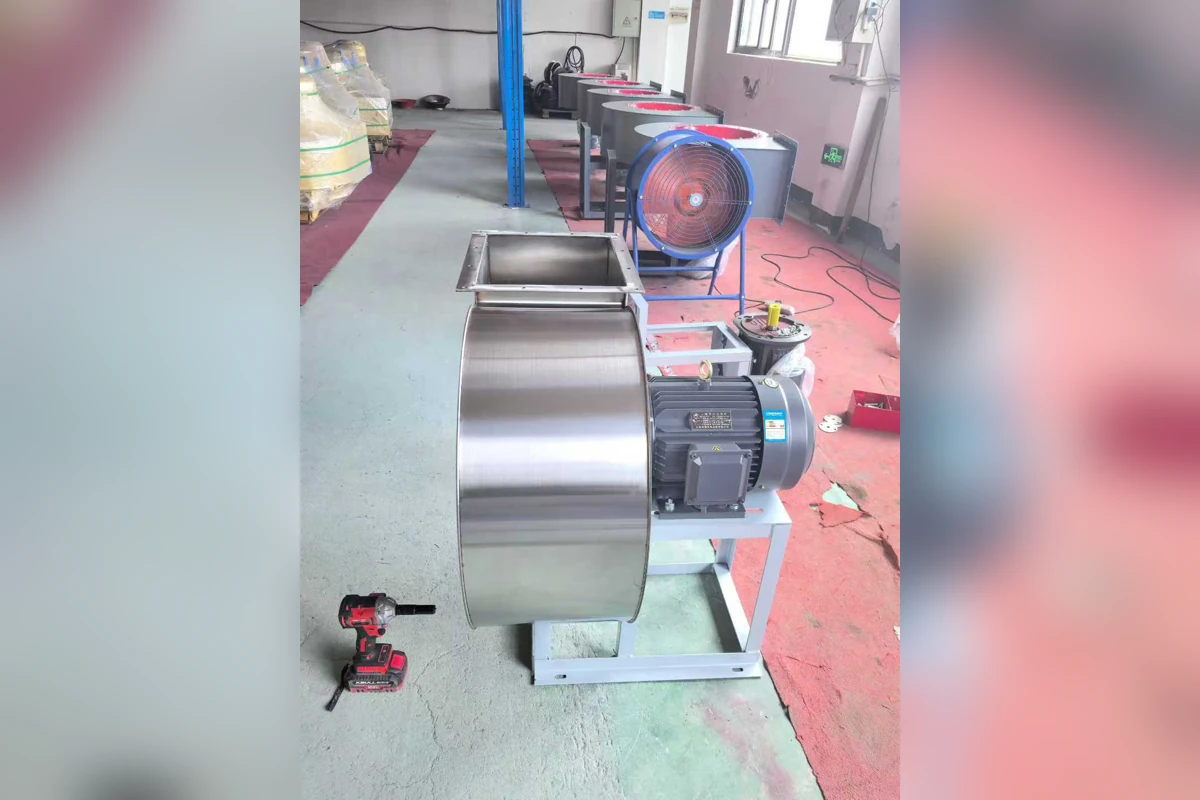
Selecting a corrosion-resistant fan starts with knowing the exact chemical species, concentration, gas temperature, and whether moisture can condense inside the casing. Dry gases that appear mild at elevated temperatures can become highly aggressive acids the moment they drop below the dew point during shutdowns.
| Wetted Material | Typical Chemical Suitability | Approximate Temp. Ceiling* | Key Limitations & Notes |
|---|---|---|---|
| Epoxy / Phenolic Coated Carbon Steel | Selected mild, dry, or low-corrosivity exhaust streams, provided the coating system is compatible with the actual chemicals and operating conditions | ~80°C – 150°C (coating-dependent) |
Lowest initial cost, but any scratch, pinhole, or dust abrasion exposes carbon steel to rapid under-film rust. |
| Stainless Steel 304 (SS304) | Some clean-air, moisture, and process exhaust duties; chemical compatibility must be checked for the actual concentration, temperature, and contaminants | No universal ceiling (verify strength and oxidation) |
Susceptible to pitting and crevice corrosion in chloride-rich (marine, HCl, salt mist) environments. |
| Stainless Steel 316L (SS316L) | Selected chloride-containing or chemical environments where corrosion data confirms suitability; not a general-purpose solution for hydrochloric acid or wet chlorine | No universal ceiling (verify strength and corrosion) |
Molybdenum improves resistance to some forms of pitting and crevice corrosion. Performance in sulfuric acid and chloride-bearing streams depends strongly on concentration, temperature, and solution chemistry. |
| FRP (Fiberglass Reinforced Plastic — Vinyl Ester) | Selected wet-acid and chemical-exhaust duties, only when the specific resin system, reinforcement, liner, concentration, and temperature have been verified. Do not assume ordinary FRP is suitable for hydrofluoric acid (HF). | ~80°C – 120°C (resin-dependent) |
Strong resistance in verified wet-acid systems, but limited by resin temperature ceiling, high impeller tip speeds, HF attack (without specialized corrosion barriers), and certain strong organic solvents. |
| Duplex stainless / 904L / nickel alloys / titanium | Specialized chemical services only where alloy-specific corrosion data supports the selection | Alloy- and service-specific | Higher material cost and longer lead time; justified where austenitic stainless steels corrode rapidly and FRP cannot meet temperature or pressure demands. |
*This table is a screening guide, not a material selection chart or fixed temperature rating. Corrosion resistance depends on chemical identity, concentration, contaminants, moisture, temperature, velocity, and shutdown conditions. Verify the complete wetted construction—including welds, fasteners, shaft sleeves, seals, and any lining—against reliable compatibility data and project process conditions.
3.1 Mechanical Details That Make or Break Corrosion Resistance
- Continuous seal welding: Standard intermittent stitch welds leave narrow crevices where acid condensate collects and accelerates crevice corrosion. Specify continuous, leak-tight welding on wetted housing seams.
- Shaft seals and purged seals: Select PTFE, elastomeric, packing, or purge-seal arrangements according to the chemical species, temperature, shaft speed, leakage limits, and seal-material compatibility. No single seal material fits all acidic or toxic gases.
- Casing drain plug: Install a threaded or flanged drain at the lowest point of the scroll so acidic condensate can be drained safely instead of pooling around the bottom of the impeller.
- Wetted fasteners and shaft sleeves: Select fasteners and shaft sleeves for the actual wet-corrosion environment, chemical exposure, and material pairing. Galvanic corrosion requires an electrically connected dissimilar-metal pair and an electrolyte; evaluate each wetted joint specifically rather than applying a blanket assumption.
Uneven corrosion thinning on impeller blades is also a primary trigger for sudden mechanical unbalance—see our industrial fan vibration troubleshooting guide for inspection indicators before structural blade failure occurs.
4. Explosion-Proof & Spark-Resistant Industrial Fans
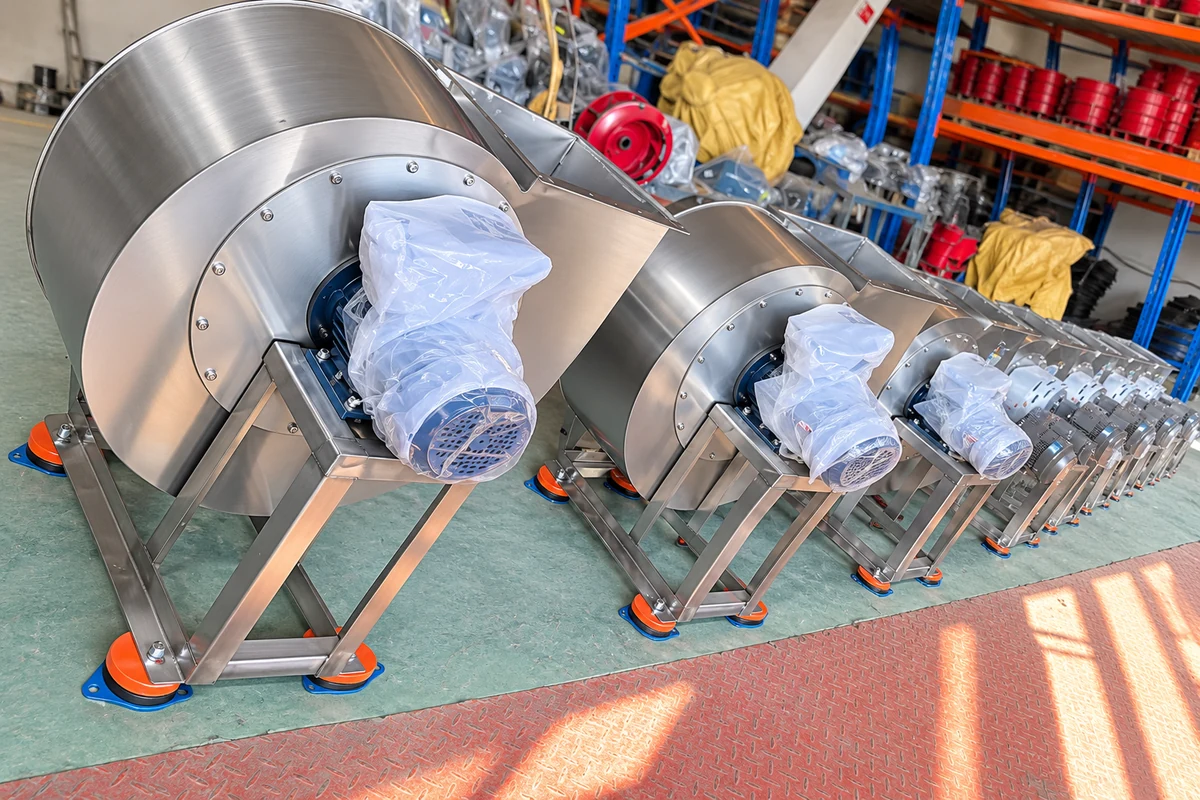
Specifying a fan for a hazardous location requires addressing two separate ignition domains: electrical equipment certification and mechanical spark prevention. Putting an explosion-proof motor on an ordinary steel fan does not make the complete fan assembly safe for explosive gas service.
4.1 Mechanical Spark-Resistant Construction (ANSI/AMCA 99-25, Section 8)
Current AMCA guidance is published in ANSI/AMCA 99-25, Section 8: Guidelines for Spark-Resistant Construction. The familiar Type A, B, and C descriptions are construction arrangements intended to reduce the risk of mechanical sparks caused by contact between rotating and stationary components. Confirm the exact build against the applicable edition and project risk assessment:
| AMCA Type | Construction Requirement | Typical Application Level | Engineering Notes |
|---|---|---|---|
| Type A | The impeller is nonferrous. Ferrous components exposed to the airstream must be arranged and protected so that they cannot be struck by particles carried in the airstream; detailed construction must meet the applicable AMCA guidance. | Used where specified Type A construction is required by the project risk assessment. | Verify alloy composition, strength at operating temperature, tip speed, corrosion compatibility, and full fan geometry. AMCA construction does not by itself certify a fan for an explosive atmosphere. |
| Type B | The impeller is nonferrous, and a nonferrous ring is provided at the shaft opening through the fan housing. | Application depends on the hazard assessment, fan design, and applicable certification requirements. | Other design details must still prevent unintended contact between components if the rotor moves within its permitted clearances. |
| Type C | Construction is arranged so that displacement of the impeller or shaft does not allow two ferrous components to contact. Where an inlet cone is provided, it must include the specified nonferrous construction or rub protection. | Considered where the project design requires a ferrous impeller and the specified clearances and protective components can be maintained. | Confirm the detailed Type C arrangement with the fan manufacturer; do not infer suitability from the type label alone. |
Compliance Clarification: AMCA spark-resistant construction is a mechanical risk-reduction measure, not a guarantee against ignition and not a standalone hazardous-area certification. Depending on the destination region, complete fan assemblies must also comply with local hazardous-area regulations such as ATEX Directive 2014/34/EU (EN 14986) in Europe, IECEx internationally, NEC / UL / CSA in North America, or EAC TR CU 012/2011 in Eurasian markets.
4.2 Electrical Certification, Static Grounding & Surface Temperature
- Hazardous-area classification: Confirm the site classification—Zone 1 / Zone 2 for gas or vapor, and Zone 21 / Zone 22 for combustible dust—or the applicable Class/Division system. For gas atmospheres, record the gas group (IIA, IIB, or IIC) and temperature class (T1–T6). For dust atmospheres, specify the required equipment protection level and maximum surface temperature based on dust-cloud and dust-layer ignition characteristics rather than substituting gas T-classes.
- Motor and accessories: Motors, terminal boxes, vibration sensors, and temperature probes installed in the hazardous zone must carry matching Ex certification (for example, Ex d / Ex db flameproof or Ex e increased safety) and suitable IP ingress protection. For mining environments with methane or coal dust, review our Underground Auxiliary Ventilation Fans Selection Guide.
- Electrostatic dissipation: On belt-driven fans, specify static-conductive (anti-static) V-belts and provide continuous electrical bonding and earth grounding across the fan casing, baseplate, flexible connectors, and motor frame.
- Maximum surface temperature: Assess the maximum surface temperature of the complete equipment under normal operation and relevant fault conditions—including blocked ducts or severely restricted flow (see our industrial fan low airflow troubleshooting guide), which can elevate internal casing and motor temperatures. For dust atmospheres, account for both dust-cloud and dust-layer ignition temperatures, layer thickness, and applicable installation rules.
5. Combined Harsh Environments: Avoiding Specification Conflicts
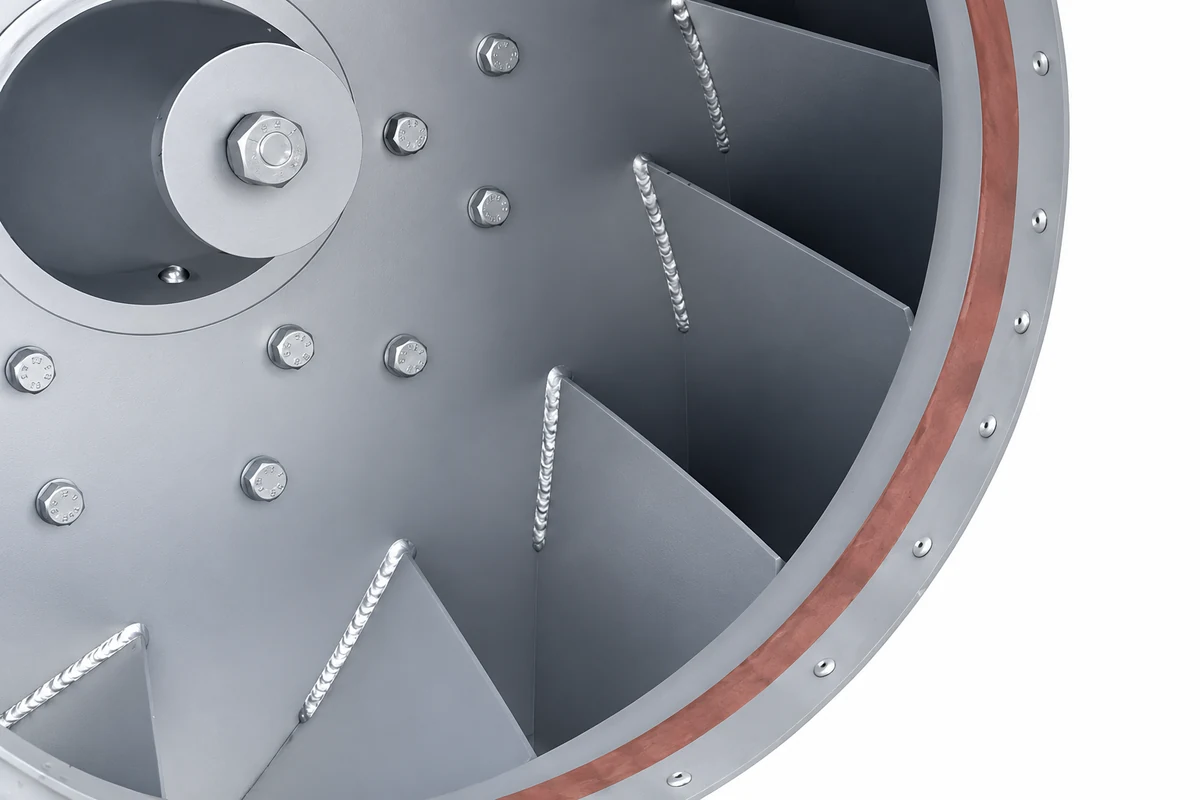
Some of the costliest procurement errors happen when a buyer combines requirements from two harsh categories without verifying material compatibility:
- High Temperature + Corrosive Gas: FRP service limits depend on resin chemistry, reinforcement, laminate design, temperature, and chemical concentration. Do not assume a standard FRP fan is suitable for hot acid gas. SS316L is also not a universal solution for acidic service; select the alloy only after checking actual corrosion data. Gas cooling or a purpose-designed high-alloy construction may be required.
- Explosive Atmosphere + Corrosive Alkali / Caustic Vapor: Aluminum alloys may be unsuitable in strong alkaline environments, while copper alloys can be incompatible with certain process chemicals. Select impeller and rub-ring materials together based on chemical compatibility and required spark-resistant construction. Conductive or static-dissipative FRP must be specifically designed, tested, and accepted for the hazardous-area application; grounding alone does not establish Ex suitability.
- Explosive Atmosphere + Underground Mining / Rusted Steel: Impact between certain light-metal alloys and rusty ferrous surfaces can create an ignition risk with high-intensity incendive sparking. Check the exact alloy restrictions and fan construction requirements in the applicable mine or site safety standard.
- High Temperature + Explosion-Proof: Process heat and bearing friction can raise the surface temperature of the fan assembly. Verify the temperature limits of the complete equipment and accessories against hazardous-area requirements; motor certification alone does not cover every external hot surface.
Before issuing a purchase order for harsh-duty equipment, verify the supplier’s welding quality, material test certificates (MTC / EN 10204 3.1), and Ex documentation using our How to Choose an Industrial Fan Supplier guide. If you are upgrading an existing corroded or heat-damaged unit whose original drawings are lost, follow our replacement fan specification checklist.
6. Harsh-Duty Technical Specification Checklist (RFQ Data)
To receive an accurate engineering selection and avoid under-specified quotes, include the following process data with your technical inquiry:
Process & Safety Data Checklist for Harsh-Duty Fans
- ☐ Duty point: required airflow (m³/h or CFM) and static or total pressure (Pa or in. WG), stating whether values are at actual hot or standard conditions.
- ☐ Gas temperature profile: normal operating temperature, peak upset temperature, and cold startup ambient temperature.
- ☐ Exact gas composition: chemical species, concentration (ppm or %), relative humidity, dew point, and presence of abrasive dust.
- ☐ Hazardous-area details (if applicable): Zone / Class & Division; gas group and T-class for gas service; dust group, equipment protection level, and maximum surface temperature for dust service; required regional conformity or certification.
- ☐ Spark-resistant requirement: applicable ANSI/AMCA 99 guidance and specified construction arrangement, or project-specific mechanical ignition-risk requirements.
- ☐ Preferred wetted material or site experience with existing equipment (e.g., SS304, SS316L, 310S, FRP, or coated carbon steel).
- ☐ Sealing and drainage needs: shaft seal type, continuous seal-welded housing, access door, and casing drain plug.
- ☐ Electrical supply (voltage, phase, 50/60 Hz), VFD operation plans, and mounting or space constraints.
7. Frequently Asked Questions
At what temperature does an industrial fan require a shaft cooling wheel (heat slinger)?
A shaft cooling wheel (heat slinger) may be considered when hot gas temperatures create an unacceptable heat load at the bearings. The often-quoted 80°C to 100°C range is only a preliminary rule of thumb, not an industry-wide threshold. The need for a cooling wheel depends on shaft heat transfer, bearing location, speed, insulation, ambient conditions, and the manufacturer’s thermal assessment.
When should I choose FRP instead of SS316L for a corrosion-resistant industrial fan?
FRP may be suitable for selected wet chemical exhaust duties when the resin, reinforcement, laminate, lining, temperature, and chemical concentration have been verified. Do not assume ordinary FRP is compatible with hydrofluoric acid (HF), and do not assume SS316L is suitable for hydrochloric acid (HCl). Compare material-specific corrosion data for the actual process conditions before selecting either material.
Is an explosion-proof motor alone enough to make an industrial fan explosion-proof?
No. While a certified explosion-proof motor protects against electrical ignition sources, the mechanical fan assembly can still generate friction sparks, electrostatic discharge, or hot bearing surfaces. A hazardous-area fan requires both an appropriately certified Ex motor and mechanical ignition protection—such as AMCA spark-resistant construction, anti-static belts, grounding, and compliance with applicable regional Ex standards (such as ATEX / EN 14986 or IECEx).
What is the difference between AMCA Spark Resistant Type A, Type B, and Type C?
ANSI/AMCA 99-25 Section 8 describes spark-resistant construction arrangements. In simplified terms, Type A uses a nonferrous impeller with exposed ferrous parts protected against particle impact; Type B uses a nonferrous impeller and a nonferrous ring at the shaft opening; Type C is designed so rotor or shaft displacement does not permit contact between two ferrous parts, with specified nonferrous inlet protection where an inlet cone is used. Confirm the detailed construction against the current standard and the fan manufacturer’s documentation.
Why do high-temperature fans trip on motor overload during cold startup?
Cold ambient air is denser than hot process gas. At the same speed and volumetric flow, the density-related component of fan pressure and power is higher in denser air. The actual cold-start load depends on the fan curve, system resistance, damper position, and speed. Check the cold-start operating point and follow the manufacturer’s approved startup procedure; a closed-damper start is not suitable for every fan.
Can carbon steel fans be used for corrosive fumes if coated with epoxy paint?
Epoxy or phenolic coatings on carbon steel can work for mild, clean, non-abrasive vapors when budget is tight, but they rely entirely on coating integrity. Once dust abrasion, mechanical damage, or installation scratches breach the coating, corrosion spreads rapidly underneath. For continuous wet acid or chloride service, select a suitable alloy, FRP system, lining, or other construction only after reviewing corrosion data for the actual chemistry, concentration, temperature, and moisture conditions. SS316L is not universally resistant to acids or chlorides.
Can GORNOVENT supply custom high-temperature, corrosion-resistant, or explosion-proof industrial fans?
Yes. GORNOVENT reviews your gas composition, operating temperature, duty point, and hazardous-area classification to supply properly engineered axial and centrifugal industrial fans in carbon steel, SS304, SS316L, 310S, or FRP—configured with heat slingers, shaft seals, spark-resistant construction, and project-compliant Ex motors.
8. Engineering References & Standards
- ANSI/AMCA 99-25, Section 8: Guidelines for Spark-Resistant Construction. Use the applicable current edition and confirm the specified fan construction with the manufacturer.
- EN 14986: Design of fans working in potentially explosive atmospheres. Confirm the edition and conformity route applicable to the destination market.
- ATEX Directive 2014/34/EU: Equipment and protective systems intended for use in potentially explosive atmospheres within its scope.
- IECEx System: International certification system for equipment used in explosive atmospheres; confirm the exact certificate, equipment marking, and scope.
- TR CU 012/2011: Eurasian Economic Union technical regulation concerning equipment for work in explosive atmospheres, where applicable.
- Material compatibility data: Verify alloy, polymer, lining, elastomer, and fastener compatibility against the exact chemical concentration, temperature, moisture, and operating cycle.
Standards and regulations are not interchangeable. The required design, testing, marking, and certification depend on the equipment category, installation location, and destination-market rules.
Conclusion
Specifying an industrial fan for high-temperature, corrosive, or explosive service is an integrated engineering decision. Reliable long-term performance depends on matching wetted metallurgy to chemical and thermal realities, isolating motors and bearings from heat and fumes, and combining certified Ex electrical components with mechanical spark protection and static grounding.
Sharing complete process gas data, peak and cold-startup temperatures, and exact hazardous-area classifications upfront prevents costly material conflicts and ensures the supplied fan operates safely throughout its service life.
Need a Fan Engineered for High-Temperature, Corrosive, or Explosive Duty?
Share your gas temperature, chemical composition, hazardous-area zone, and duty point with the GORNOVENT engineering team. We will recommend the right metallurgy, drive isolation, sealing, and Ex configuration with full technical drawings and performance curves.
Operating and peak temperatures, chemical vapor or acid composition, Zone / Gas Group / T-class (or dust class and max surface temp), and required Ex certification.
Airflow, static pressure, preferred material (SS304, SS316L, 310S, FRP), AMCA spark-resistant type, and electrical supply.
Please include your process datasheet, gas composition, and applicable regional Ex standards. Final material compatibility, structural temperature limits, and hazardous-area compliance should be confirmed against project specifications before fabrication.

